MERN Stack Development Course in Coimbatore
Build Dynamic Web Applications with MERN Stack and Master Modern Frontend & Backend Technologies
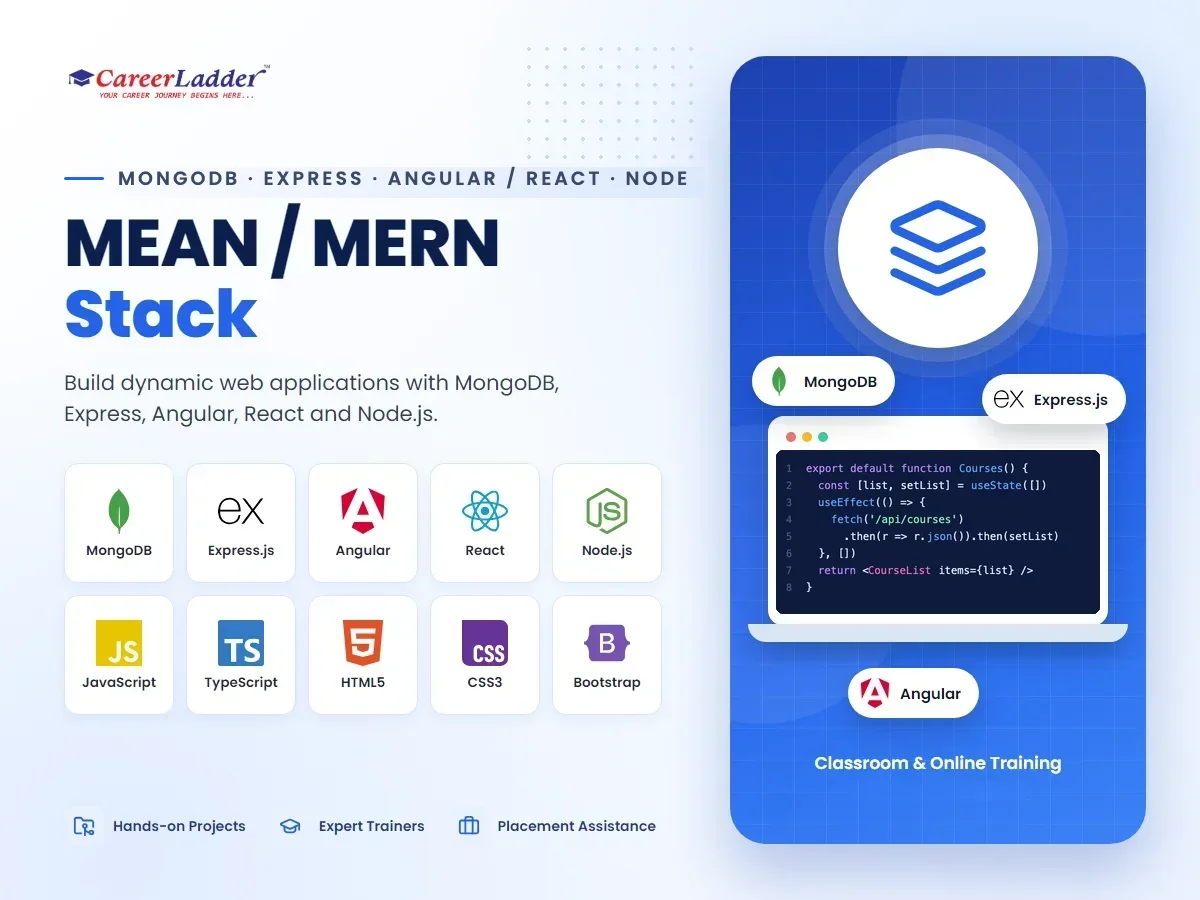
About the MEAN / MERN Stack Course
Specialize in JavaScript-based full stack development using MongoDB, Express, Angular/React, and Node.js.
Train at our Avinashi Road (Hope College, Peelamedu) or Sundarapuram branch in Coimbatore — or join online — with hands-on projects, industry mentors, and dedicated placement support from day one.
The MEAN / MERN Stack course at Career Ladder is a specialist program for learners who want engineering-grade depth in the JavaScript stack that powers most modern web products: MongoDB, Express.js, React (or Angular on the MEAN path), and Node.js. Where a generalist full stack course surveys the whole landscape, this course drills into how each layer actually behaves in production — how MongoDB executes and optimises queries, how Express middleware pipelines are architected, how React reconciles and re-renders, and how the Node event loop handles thousands of concurrent connections. The result is a developer who does not just make features work, but understands why they work and how to make them fast.
Depth is the whole point of this track. You will spend real time on topics most bootcamps skip: MongoDB aggregation pipelines and indexing strategy, schema design trade-offs, Express project architecture with layered controllers and services, advanced React patterns like memoisation and code splitting, Node.js streams and clustering, API testing, and performance profiling. The course also covers Angular fundamentals so you can honestly claim the MEAN variant on your resume — many enterprise teams in India still run Angular front ends, and being conversant in both doubles your interview surface area.
For Coimbatore learners this specialisation pays off directly. The city's SaaS and product startups — many clustered around the TIDEL Park and KGISL ecosystem — build primarily on Node and React, and they interview for depth: candidates get asked about indexing, async behaviour, and state management design, not just syntax. Services companies with local delivery centres also staff long-running MERN projects for overseas clients. A specialist profile with strong fundamentals and production-style projects stands out sharply in this market against the flood of certificate-only applicants.
This course is a natural second step for students who completed our React JS front-end course and now want to own the server and database too, though motivated beginners with solid JavaScript can join directly. As with every Career Ladder program — backed by a 4.6-star rating from 1,500+ Google reviews and 10,000+ trained students — you get classroom batches at Hope College and Sundarapuram plus online options, and placement assistance covering resume building, mock interviews, and hiring-partner referrals once your projects are complete.
Course Syllabus
Module-by-module curriculum — expand each to see the topics covered.
Module 1:JavaScript Deep Dive for Stack Developers+
- Execution context, hoisting, closures, and the this keyword
- Prototypes, classes, and object composition
- Event loop internals: microtasks, macrotasks, and async ordering
- Promises in depth, async/await error patterns
- Higher-order functions and functional array methods
- TypeScript essentials for safer stack code
Module 2:Node.js Internals & Server Fundamentals+
- Node architecture: V8, libuv, and non-blocking I/O
- Module systems: CommonJS vs ES modules
- File system, buffers, and streams for large data
- Events and EventEmitter patterns
- Process management, clustering, and worker threads
- Debugging and profiling Node applications
Module 3:Express.js Architecture & API Engineering+
- Routing, middleware chains, and error-handling middleware
- Layered architecture: routes, controllers, services, repositories
- Request validation with schema validators
- Versioning, pagination, and consistent API response design
- Logging, rate limiting, and security middleware (helmet, CORS)
- API documentation with Swagger/OpenAPI
Module 4:MongoDB Mastery: Modelling, Aggregation & Indexing+
- Schema design patterns: embedding vs referencing, bucketing
- Mongoose advanced features: virtuals, middleware, transactions
- Aggregation pipelines: $match, $group, $lookup, $facet
- Index types, compound indexes, and reading explain plans
- Geospatial and text search queries
- Backup, Atlas cloud deployment, and performance tuning
Module 5:React for Production Applications+
- Component design systems and folder architecture
- Hooks in depth: useMemo, useCallback, useReducer, useRef
- Performance: re-render analysis, memoisation, lazy loading
- Data fetching patterns and caching strategies
- Forms at scale with validation libraries
- Error boundaries and suspense patterns
Module 6:State Management & Frontend Data Layer+
- Redux Toolkit architecture for large applications
- RTK Query for API caching and invalidation
- Context vs Redux vs server-state tools — choosing correctly
- Optimistic updates and offline-tolerant UX
- Persisting and rehydrating state
Module 7:Angular Essentials (the MEAN Path)+
- Angular CLI, components, and templates
- Modules, services, and dependency injection
- Two-way binding and reactive forms
- HTTP client and observables with RxJS basics
- When enterprises choose Angular vs React
Module 8:Authentication, Real-Time & Advanced Backend Features+
- JWT with refresh tokens and secure cookie strategies
- OAuth social login integration
- Role- and permission-based authorisation design
- Real-time features with Socket.IO (chat, notifications)
- Payment gateway integration workflow
- Scheduled jobs, queues, and email services
Module 9:Testing, Git Workflow & Deployment+
- Unit and integration testing for Node APIs (Jest, Supertest)
- React component testing fundamentals
- Git team workflows: feature branches, rebases, code review
- Dockerising a MERN application
- CI basics and deploying to cloud platforms with a custom domain
- Environment management across dev, staging, and production
Module 10:Capstone, System Design Basics & Interview Preparation+
- Low-level system design questions for MERN interviews
- Building and defending a production-grade capstone
- Data structures and algorithms practice in JavaScript
- Resume building focused on specialist MERN keywords
- Mock interviews with stack-specific deep-dive rounds
- Hiring-partner referrals through the placement cell
Who Should Join This Course
Real-World Projects You Will Build
- 1Multi-vendor marketplace API and storefront: sellers, products, orders, and reviews modelled in MongoDB with aggregation-driven sales analytics, plus a React storefront with RTK Query caching.
- 2Real-time team chat and notification platform: Socket.IO channels, online presence, message persistence, and infinite-scroll history — a classic interview talking point for event-driven Node.
- 3Hospital or clinic appointment system: role-based dashboards for patients, doctors, and admins, slot-conflict logic, and automated email reminders via scheduled jobs.
- 4Expense-sharing application (Splitwise-style): complex balance calculations in aggregation pipelines, settlement flows, and optimistic UI updates on the React side.
- 5Angular admin dashboard: rebuild one project's admin panel in Angular with reactive forms and RxJS, so your portfolio credibly demonstrates both MEAN and MERN.
- 6Load-tested capstone of your own scoping: profiled with realistic data volumes, indexed and optimised, containerised with Docker, and deployed with a live URL and documented API.
Career Scope & Opportunities
MERN specialists occupy one of the most consistently in-demand niches in Indian software hiring. Because the entire stack runs on JavaScript, companies staff smaller teams that ship faster, and they pay for candidates who demonstrate genuine depth — the ability to design a schema, write an aggregation pipeline, or explain why an API is slow. Specialist depth is precisely what separates shortlisted candidates from the thousands of generic "full stack" resumes on job portals.
Common roles after this course include MERN Stack Developer, Node.js Backend Developer, React Developer, and Full Stack Engineer (JavaScript). Indian market compensation for freshers in these roles typically falls in a broad range of about 3 to 6 LPA, with product companies and funded startups often at the higher end; specialists with two to five years of experience frequently reach the 8 to 15 LPA band, and strong Node back-end profiles are among the better-paid web roles. Treat these as indicative market figures that vary by company, city, and interview performance.
Coimbatore's hiring landscape suits this specialisation well. The local SaaS scene builds overwhelmingly on Node and React, IT parks such as TIDEL Park host teams delivering JavaScript projects for global clients, and even traditional manufacturing and retail businesses digitising their operations commission MERN applications through local agencies. Remote-first startups across India also hire Coimbatore-based MERN developers, making this one of the few specialist paths where you can earn metro-level salaries while living locally.
After you finish your capstone, Career Ladder's placement assistance takes over: resume building that foregrounds your specialist projects and keywords, mock interviews that simulate the deep-dive technical rounds MERN candidates actually face, and referrals to hiring partners with matching openings. Longer term, MERN specialists progress naturally into senior backend, lead engineer, or architect tracks, and the stack knowledge transfers directly if you later add TypeScript-heavy frameworks or cloud specialisations.
What You Will Master
Career Outcomes
100% Placement Assistance
Resume building, mock interviews, and direct referrals to our hiring partners — until you land the role.
Frequently Asked Questions
What is MERN Stack Development?+
MERN is a popular full-stack JavaScript solution for building dynamic web applications. It consists of MongoDB, Express.js, React, and Node.js.
Is prior JavaScript knowledge required for MERN?+
Yes, a good understanding of JavaScript is recommended as the entire stack is JavaScript-based. We will cover advanced concepts as part of the course.
Do you offer placement for MERN Stack freshers?+
Yes, our 100% placement assistance program includes resume building and direct campus drives for Coimbatore students.
Should I take this course or the AI Integrated Full Stack course?+
Choose by depth versus breadth. This MERN/MEAN course goes significantly deeper into MongoDB aggregation and indexing, Express architecture, Node internals, and advanced React — the material specialist interviews test. The AI Integrated Full Stack course trades some of that depth for breadth plus OpenAI and LangChain integration. Beginners who want the widest foundation often start there; developers targeting specialist JavaScript roles belong here.
Does the course cover MEAN (Angular) or only MERN (React)?+
Both. React is the primary front-end framework throughout the course, and a dedicated Angular module covers components, services, dependency injection, and reactive forms so you can work on MEAN projects too. Since many enterprise teams in India maintain Angular front ends, being credible in both frameworks widens the set of interviews you qualify for.
How much MongoDB depth does this course really go into?+
Considerably more than a typical full stack course. You will design schemas using embedding and referencing patterns, write multi-stage aggregation pipelines with $lookup and $facet, create and evaluate indexes using explain plans, use transactions, and deploy to MongoDB Atlas. Database questions are where MERN interviews get hard, so we treat this module as a centrepiece rather than a checkbox.
I completed the React JS course at Career Ladder. Do I repeat the React portions here?+
No — you will build on them. The React modules in this course focus on production-level topics such as performance profiling, memoisation, RTK Query, and architectural patterns, which go beyond the front-end course's scope. React JS course graduates typically move through the front-end modules faster and spend the saved time on Node and MongoDB depth.
What kind of interview preparation is specific to this course?+
The final module targets exactly what MERN interviews test: event-loop and async questions, aggregation and indexing scenarios, state-management design discussions, small system-design exercises, and JavaScript data-structure problems. The placement team then runs mock interviews in that format and refers you to hiring partners, alongside standard resume building support.
Our Coimbatore Branches
Hope College (Peelamedu)
1st Floor, 267, Avinashi Road, Opposite GRG Ladies Hostel, Above Sneha Hospital, Hope College, Coimbatore 641004
+91 88702 75880
Sundarapuram
1st Floor, Bank of Baroda Building, 5, Madukkarai Main Rd, opp. Abirami Hospital, Sundarapuram, Coimbatore
+91 88070 28071
Related Courses
AI Integrated Full Stack Development
Master both front-end and back-end development with AI integration to build intelligent web applications.
AI Powered Automation Testing
Learn about automated testing frameworks and how to ensure quality and reliability in software development.
Blockchain Development
Learn Solidity, Ethereum, and Smart Contracts to build decentralized applications (DApps).