Agentic AI & AI Agents Course
Build Autonomous AI Systems and Future-Ready AI Agents
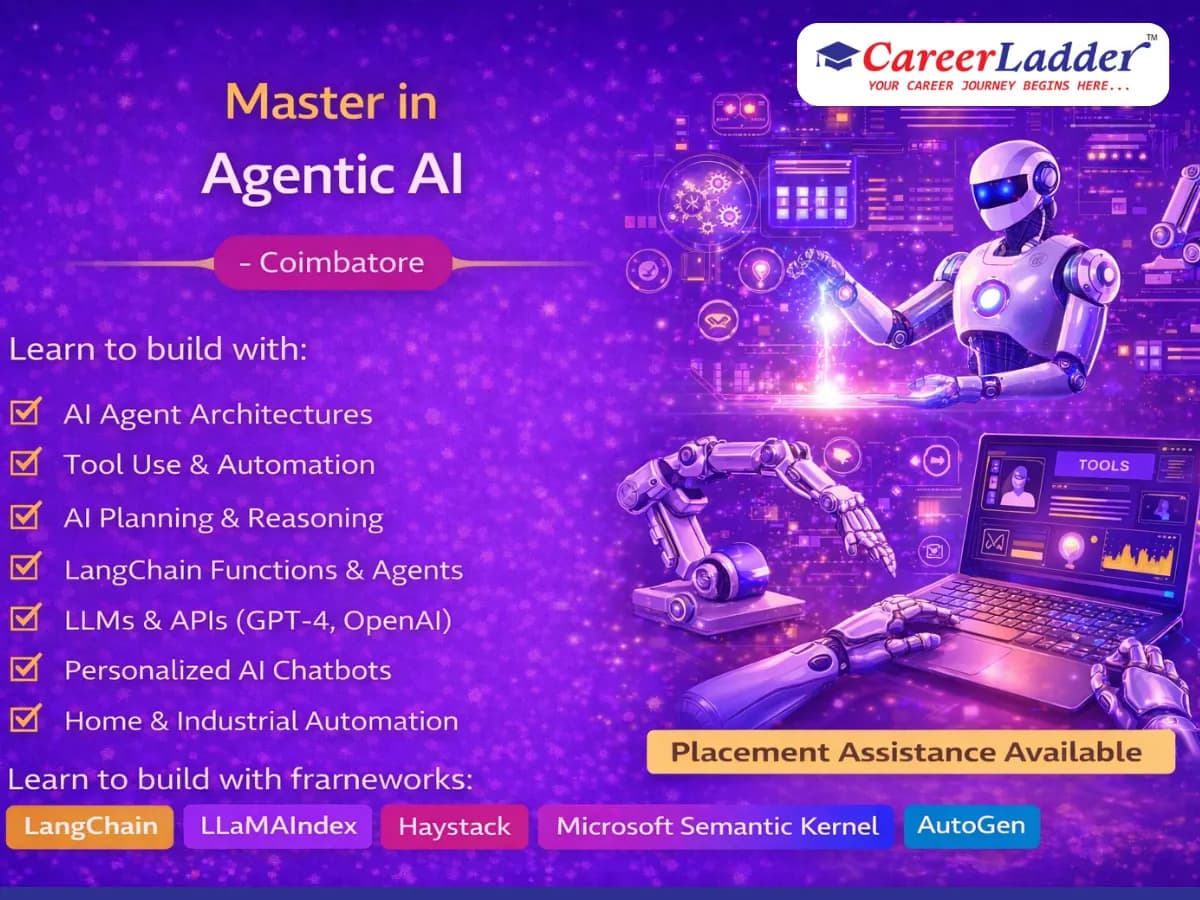
About the Agentic AI & AI Agents Course
Build autonomous AI systems using LangChain, AutoGPT, and Multi-Agent workflows. The future of AI is Agentic.
Train at our Avinashi Road (Hope College, Peelamedu) or Sundarapuram branch in Coimbatore — or join online — with hands-on projects, industry mentors, and dedicated placement support from day one.
Agentic AI is the next stage after generative AI: instead of a model that answers one prompt at a time, an agent can plan a multi-step task, call tools — search, APIs, databases, code execution — check its own results, and keep working until the goal is met. In 2026 this is where serious engineering demand is heading, as companies move from chatbots to AI systems that actually complete work: researching, processing documents, operating software, and automating entire business workflows. This course teaches you to design and build such systems.
The curriculum is architecture-focused. You learn the agent loop — reasoning, tool selection, action, observation — then build it properly with LangChain and LangGraph for stateful, controllable agents, study the designs behind AutoGPT and BabyAGI, and progress to multi-agent systems where specialised agents (a researcher, a writer, a reviewer) collaborate on complex tasks. Memory is treated as a first-class topic: short-term conversational state, long-term persistence, and retrieval over vector databases like Pinecone, ChromaDB, and Weaviate so agents remember and ground their work.
Just as important, the course teaches the engineering discipline agents demand: guardrails and human-in-the-loop approval for sensitive actions, cost and latency budgeting, evaluation and tracing of agent runs, and knowing when a simple chain beats an autonomous agent. This judgement — not framework syntax — is what employers test when hiring for agentic roles, and it is what distinguishes this course from a weekend LangChain tutorial.
The timing suits Coimbatore well: automation is the city’s native language, from its manufacturing backbone to the SaaS and services teams around TIDEL Park Coimbatore and KGISL now building AI-driven workflow products for global clients. Career Ladder — trained 10,000+ students, rated 4.6 stars across 1,500+ Google reviews — runs the course in classroom mode at Hope College (Avinashi Road) and Sundarapuram and live online, with placement assistance including resume building, mock interviews, and hiring-partner referrals.
Course Syllabus
Module-by-module curriculum — expand each to see the topics covered.
Module 1:Agentic AI Foundations+
- From chatbots to agents: what autonomy actually means
- The agent loop: plan, act, observe, reflect
- ReAct, plan-and-execute, and reflection patterns
- Anatomy of real agentic products in 2026
- When to use an agent vs a simple LLM chain
Module 2:LLM and Python Groundwork for Agents+
- LLM APIs revisited: roles, context, and structured outputs
- Function/tool calling — the primitive behind every agent
- Python patterns: typing, Pydantic schemas, and async
- Handling model errors, retries, and timeouts
- Token budgeting and cost control for looping systems
Module 3:Building Agents with LangChain+
- Chains, prompts, and output parsers as building blocks
- Defining tools: search, calculators, APIs, and Python REPL
- Agent executors and controlling iteration limits
- Conversation memory in agent contexts
- Debugging agent reasoning with tracing (LangSmith-style workflows)
Module 4:Stateful Agents with LangGraph+
- Why graphs: modelling agent workflows as nodes and edges
- State management and conditional routing
- Cycles, checkpoints, and resumable executions
- Human-in-the-loop interrupts for approvals
- Building a production-style stateful agent end to end
Module 5:Tool Use, RAG, and Agent Memory+
- Giving agents retrieval: RAG as a tool in the loop
- Vector databases: Pinecone, ChromaDB, and Weaviate integration
- Short-term vs long-term memory architectures
- Entity memory and user-profile persistence across sessions
- Grounding agent outputs to reduce hallucinated actions
Module 6:Autonomous Agent Architectures+
- AutoGPT and BabyAGI: task queues, self-prompting, and lessons learned
- Goal decomposition and planning strategies
- Self-correction: agents that critique and retry their own work
- Failure modes: loops, drift, and runaway costs
- Sandboxing and safe execution of agent-generated code
Module 7:Multi-Agent Systems and Orchestration+
- Why multiple specialised agents beat one generalist
- Role design: researcher, coder, reviewer, and manager agents
- Communication patterns and shared state between agents
- Orchestration frameworks: CrewAI-style crews and LangGraph supervisors
- Evaluating multi-agent output quality and cost trade-offs
Module 8:Production Concerns: Safety, Evaluation, and Deployment+
- Guardrails: permissions, action whitelists, and approval gates
- Observability: logging, tracing, and replaying agent runs
- Evaluation harnesses for agent tasks
- Deploying agents behind APIs and scheduling background runs
- Security basics: prompt injection and untrusted tool output
Module 9:Capstone: An Autonomous System of Your Own+
- Scoping an agentic capstone with real-world value
- Architecture review: tools, memory, state, and guardrails
- Build sprints with mentor checkpoints
- Cost, reliability, and safety audit of your agent
- Demo day: presenting and defending your system design
Who Should Join This Course
Real-World Projects You Will Build
- 1Research-and-report agent: give it a topic and it plans searches, gathers sources, cross-checks claims, and produces a structured, cited report.
- 2Invoice and document processing agent: watches an inbox-style folder, extracts fields from PDFs, validates them against rules, and files clean records — classic back-office automation for Coimbatore businesses.
- 3Customer-operations agent with memory: handles support conversations across sessions, retrieves order data via tools, and escalates to a human with a case summary when needed.
- 4Multi-agent content studio: a planner, writer, fact-checker, and editor agent collaborating through LangGraph to produce publish-ready content.
- 5Code-assistant agent: reads a repository, plans a small feature or fix, writes and tests the code in a sandboxed REPL, and reports its diff for human approval.
- 6Capstone: design and build your own autonomous system — with tools, persistent memory, guardrails, and tracing — and defend its architecture in a mock design review.
Career Scope & Opportunities
Agentic AI is where the LLM job market is visibly heading: analyst reports and enterprise roadmaps through 2026 consistently place autonomous and semi-autonomous agents at the centre of AI investment, and job boards now carry titles that barely existed two years ago — Agentic AI Engineer, AI Agent Developer, Agentic Workflow Architect, and LLM Application Developer with agent experience. Companies that spent the last two years on chatbots are upgrading them into systems that act, and they need engineers who can do it safely.
Because the specialisation is new and genuinely scarce, compensation trends above general development: freshers with strong Python plus demonstrable agent projects typically see 5-8 LPA in the Indian market, while engineers with 2-4 years of software experience who add agentic skills commonly command 12-25 LPA depending on company and depth. These are indicative, fast-moving ranges — in an emerging field, a convincing portfolio of working agents outweighs years of unrelated experience.
Coimbatore’s relevance is practical: the SaaS and IT services companies around TIDEL Park Coimbatore and KGISL are building AI automation for global clients, large employers in the Cognizant and TCS orbit are standing up agentic delivery teams, and the city’s manufacturing digitisation creates workflow-automation problems agents are built for. Since agentic work is largely remote-friendly, you also compete for national and international roles from Coimbatore.
Career Ladder’s placement assistance matches how these roles are filled: your resume is built around the agents you have shipped, mock interviews cover system design questions specific to agent architectures, and hiring-partner referrals target teams hiring for LLM and automation engineering.
What You Will Master
Career Outcomes
100% Placement Assistance
Resume building, mock interviews, and direct referrals to our hiring partners — until you land the role.
Frequently Asked Questions
What is Agentic AI?+
Agentic AI refers to AI systems that can pursue complex goals with limited direct supervision, making decisions and taking actions to achieve objectives autonomously.
Do I need prior coding experience?+
Yes, proficiency in Python and a basic understanding of AI/LLMs is recommended. However, we cover the essentials of Agentic frameworks from scratch.
What tools will I learn?+
You will master frameworks like LangChain, LangGraph, AutoGPT, and work with LLMs (OpenAI, Llama) and Vector Databases.
How long does the Agentic AI course take?+
The programme typically runs about 3 to 4 months, including the capstone build. Weekday and weekend batches are available, and the pace assumes you are practising between sessions since agent-building is heavily hands-on.
Should I take the Generative AI course before this one?+
If you are new to LLMs, yes — the Generative AI course covers prompting, APIs, and RAG fundamentals that this course builds on. If you already work with Python and have used LLM APIs or LangChain, you can join Agentic AI directly; the groundwork module refreshes the essentials.
How is Agentic AI different from Generative AI?+
Generative AI focuses on getting good outputs from models — text, answers, images — through prompting and RAG. Agentic AI is about systems that take actions: planning multi-step tasks, calling tools, maintaining memory, and working autonomously toward goals. This course is the engineering layer on top of GenAI skills.
What job roles does this course prepare me for?+
Agentic AI Engineer, AI Agent Developer, LLM Application Developer, and Agentic Workflow Architect, plus broader AI engineering roles where agent experience is a strong differentiator. Automation and RPA professionals also use it to transition into AI-driven automation roles.
Is this course available online as well as in the classroom?+
Yes. You can attend classroom batches at our Hope College or Sundarapuram branches in Coimbatore, or join the same live sessions online. Projects, mentor reviews, and placement assistance are identical in both modes.
Our Coimbatore Branches
Hope College (Peelamedu)
1st Floor, 267, Avinashi Road, Opposite GRG Ladies Hostel, Above Sneha Hospital, Hope College, Coimbatore 641004
+91 88702 75880
Sundarapuram
1st Floor, Bank of Baroda Building, 5, Madukkarai Main Rd, opp. Abirami Hospital, Sundarapuram, Coimbatore
+91 88070 28071
Related Courses
Data Science with Machine Learning
Dive into Data Science and explore machine learning, big data, and predictive modeling.
AI Powered Data Analytics
Learn how to analyze and interpret data to help businesses make informed decisions.
Power BI Data Analytics
Transform raw data into meaningful insights with Microsoft Power BI, SQL, and Advanced Excel.