AI Course in Coimbatore
Master Artificial Intelligence and Automation with Job-Oriented Training
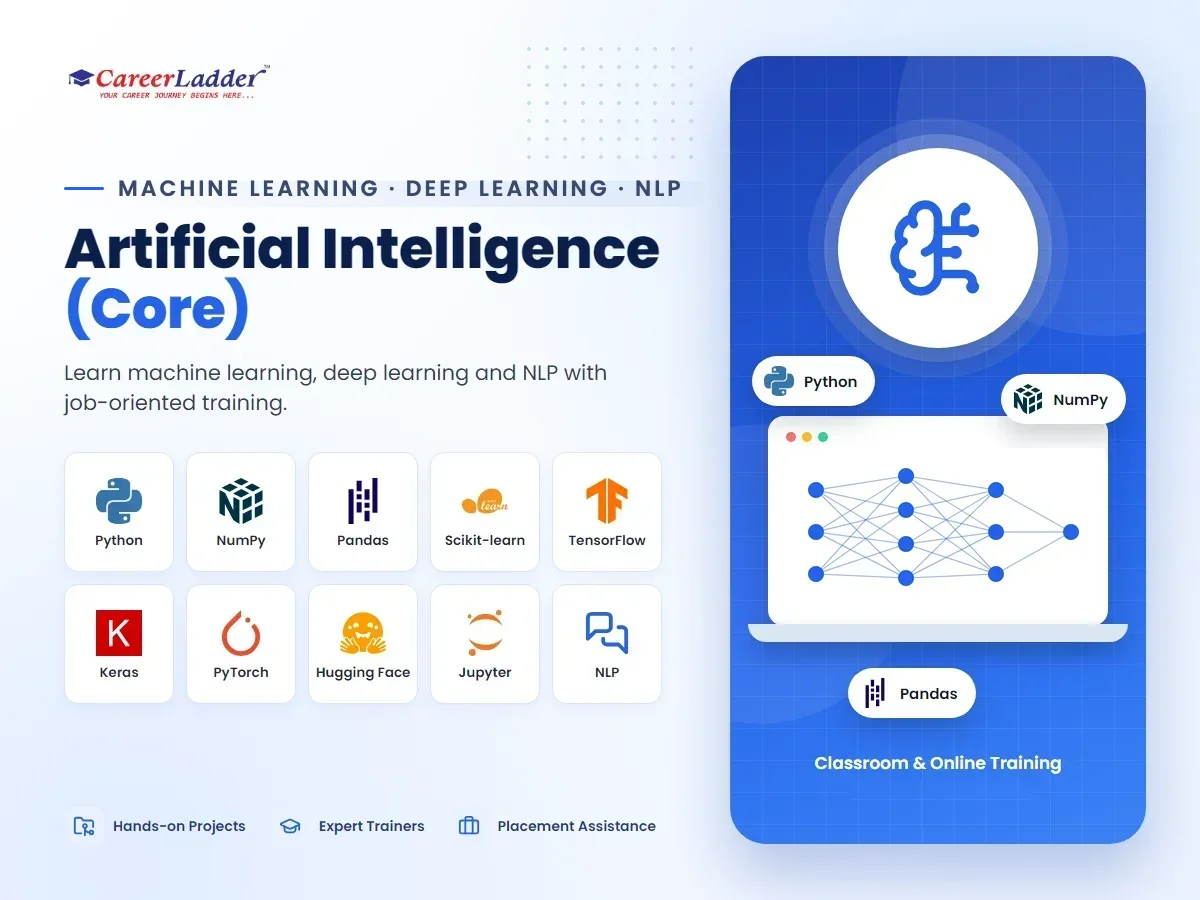
About the Artificial Intelligence (Core) Course
Dive deep into AI concepts such as neural networks, machine learning, and robotics.
Train at our Avinashi Road (Hope College, Peelamedu) or Sundarapuram branch in Coimbatore — or join online — with hands-on projects, industry mentors, and dedicated placement support from day one.
Artificial Intelligence is no longer a niche specialisation — it is becoming the base layer of modern software, and companies increasingly expect engineers who understand how intelligent systems actually work under the hood. This core AI course builds those foundations properly: Python programming, the mathematics of learning algorithms, classical machine learning with scikit-learn, deep learning with TensorFlow and Keras, natural language processing, and computer vision, along with AI-driven automation so you can apply models to real workflows.
The word "core" matters. Plenty of short courses teach people to call an AI API without understanding what happens inside. This programme takes the opposite route: you learn how models are trained, why they fail, how to evaluate them honestly, and how neural networks actually learn from data. That depth is what lets you move confidently into any AI direction later — data science, generative AI, or agent-based systems — because you understand the machinery underneath all of them. The course also connects AI to automation in a practical way, using Selenium and Python scripting alongside testing frameworks, so you can apply intelligence to real workflows rather than leaving models stranded in notebooks.
Coimbatore has a real stake in AI adoption. The city’s manufacturing and textile industries are investing in automation, predictive maintenance, and quality inspection — all AI-heavy problems — while IT services and product teams around TIDEL Park Coimbatore and KGISL build AI features for global clients. With companies like Bosch, Cognizant, and TCS active in the region, foundational AI skills open doors both in local industry and in the wider Indian market.
Career Ladder delivers the course in classroom mode at its Hope College (Avinashi Road) and Sundarapuram branches and as live online training with the same curriculum. The institute has trained over 10,000 students, carries a 4.6-star rating from 1,500+ Google reviews, and backs the course with placement assistance covering resume building, mock interviews, and referrals to hiring partners.
Course Syllabus
Module-by-module curriculum — expand each to see the topics covered.
Module 1:Python Programming Foundations+
- Python syntax, data structures, and control flow
- Functions, modules, and object-oriented programming
- NumPy for numerical computing
- Pandas for loading and preparing datasets
- Matplotlib for visualising data and results
Module 2:Mathematics for AI+
- Linear algebra: vectors, matrices, and transformations
- Calculus intuition: gradients and optimisation
- Probability and statistics for model evaluation
- Loss functions and what "learning" mathematically means
- Worked entirely through Python code, not blackboard theory
Module 3:Machine Learning with Scikit-Learn+
- The ML workflow: data, features, training, evaluation
- Regression and classification algorithms
- Decision trees, random forests, and boosting
- Clustering and unsupervised learning
- Cross-validation, overfitting, and hyperparameter tuning
- Model metrics: precision, recall, F1, ROC-AUC
Module 4:Deep Learning with TensorFlow and Keras+
- Neurons, layers, activation functions, and backpropagation
- Building and training networks in Keras
- Convolutional neural networks for images
- Recurrent architectures and sequence data
- Transfer learning with pre-trained models
- Regularisation, dropout, and training diagnostics
Module 5:Natural Language Processing+
- Text preprocessing with NLTK and spaCy
- Tokenisation, embeddings, and text representation
- Text classification and sentiment analysis
- Named entity recognition and information extraction
- How transformers changed NLP — the bridge to modern LLMs
Module 6:Computer Vision Fundamentals+
- Image data and OpenCV basics
- Image classification with CNNs
- Object detection concepts
- Practical use cases: defect detection and OCR
- Vision applications in manufacturing quality control
Module 7:AI-Powered Automation+
- Automation fundamentals with Selenium WebDriver
- Python scripting for workflow automation
- Testing frameworks: TestNG, JUnit, and Cucumber overview
- AI-assisted test generation and self-healing automation concepts
- Where AI plugs into QA and business process automation
Module 8:Working with Modern AI Services+
- Calling AI APIs from Python applications
- Using pre-trained models responsibly in products
- Prompting basics and where GenAI fits alongside classical ML
- AI ethics: bias, privacy, and responsible deployment
- Choosing between training your own model and using a service
Module 9:Capstone Project and Deployment+
- Framing a real problem as an AI task
- Building, evaluating, and iterating on your model
- Serving a model through a simple Flask/FastAPI endpoint
- Git, documentation, and presenting your work
- Mock technical review of your capstone
Who Should Join This Course
Real-World Projects You Will Build
- 1Image-based defect detection: train a CNN to classify product images as pass or defect, mirroring quality-inspection use cases in Coimbatore manufacturing.
- 2Loan approval predictor: build and evaluate a classification model on financial data, handling imbalance and explaining which features drive decisions.
- 3Sentiment analysis engine: process customer reviews with spaCy and a deep learning classifier, exposing results through a small API.
- 4Handwritten digit and document OCR pipeline: combine computer vision preprocessing with a trained recogniser for form digitisation.
- 5AI-assisted test automation suite: build a Selenium framework enhanced with Python scripts that auto-generate and prioritise test cases.
- 6Capstone: choose a domain problem, take it from dataset to trained model to deployed demo, and defend your design choices in a mock panel review.
Career Scope & Opportunities
India’s AI job market is expanding across two fronts at once: dedicated AI/ML engineering roles, and conventional software roles that now list ML familiarity as a requirement. Entry designations after a foundations course like this include Junior AI Engineer, Machine Learning Engineer (entry level), AI/ML Developer, Data Scientist (junior), and AI-focused QA/automation roles. Importantly, foundational skills age slowly: frameworks and model names change every year, but candidates who can explain training, evaluation, and failure modes stay employable across those shifts.
Fresher compensation for AI-adjacent roles in India typically sits around 4-6 LPA, somewhat above generic software roles, because supply of properly-trained candidates still lags demand. Engineers with 3-5 years of hands-on model-building experience commonly command 10-18 LPA in the Indian market, with product companies paying at the higher end. These are indicative ranges — portfolios and interview depth decide actual offers.
Around Coimbatore, AI opportunity is broader than pure software: services and product teams at TIDEL Park Coimbatore and KGISL work on client AI projects, companies in the Bosch, Cognizant, and TCS orbit hire ML-literate engineers, and the city’s manufacturing and textile digitisation push is creating applied-AI problems in vision inspection, demand forecasting, and predictive maintenance. Foundational AI skills also travel well to Bengaluru, Chennai, and remote roles.
Because AI interviews probe fundamentals hard — bias/variance, evaluation metrics, why a model fails — Career Ladder’s placement assistance leans into exactly that: mock interviews on ML theory and your projects, a resume rebuilt around demonstrable work, and hiring-partner referrals once you are ready.
What You Will Master
100% Placement Assistance
Resume building, mock interviews, and direct referrals to our hiring partners — until you land the role.
Frequently Asked Questions
Is this AI course suitable for beginners?+
Yes, we start from the absolute basics of Python and Mathematics required for AI, making it perfect for beginners.
What tools are covered in Automation Testing?+
We cover Selenium, TestNG, Maven, Jenkins, and AI-powered testing tools.
Does CareerLadder provide placement in Coimbatore?+
Yes, we have a 100% placement assistance program with dedicated mock interviews for Coimbatore students.
How long is the AI course?+
The full programme typically runs 4 to 5 months, covering Python, machine learning, deep learning, NLP, and the capstone. Weekday and weekend batches are available for students and working professionals.
How is this course different from the Generative AI course?+
This course builds core AI and machine learning foundations — training models, deep learning, NLP, and computer vision. The Generative AI course assumes some of those basics and specialises in LLMs, prompting, and RAG applications. If you are starting fresh and want depth, begin here; if you already know ML, go straight to Generative AI.
How much mathematics do I need before joining?+
School-level comfort with maths is enough. The dedicated Mathematics for AI module rebuilds linear algebra, probability, and gradient intuition through Python code, so you learn exactly the maths the algorithms use — no more, no less.
What jobs can I apply for after finishing?+
Typical targets are Junior AI Engineer, ML Engineer, AI/ML Developer, and AI-focused automation roles. The course also positions you for data science openings, since the ML core overlaps heavily with what those interviews test.
Do I receive a certificate on completion?+
Yes, Career Ladder issues a completion certificate after you finish the modules and capstone. In AI hiring, the certificate opens the conversation but your project portfolio and fundamentals win the interview, so the course invests heavily in both.
Our Coimbatore Branches
Hope College (Peelamedu)
1st Floor, 267, Avinashi Road, Opposite GRG Ladies Hostel, Above Sneha Hospital, Hope College, Coimbatore 641004
+91 88702 75880
Sundarapuram
1st Floor, Bank of Baroda Building, 5, Madukkarai Main Rd, opp. Abirami Hospital, Sundarapuram, Coimbatore
+91 88070 28071
Guides From Our Blog
How to Start a Generative AI Career in 2026: A Coimbatore Guide
A practical guide to starting a Generative AI career in 2026: the skills that matter (prompt engineering, RAG, LLM APIs), realistic timelines, and how the Coimbatore job market is adopting GenAI.
Read the guide →AI Career Roadmap for Freshers and Non-IT Graduates (2026)
A realistic 2026 roadmap into AI careers for freshers and non-IT graduates: which AI role fits your background, the month-by-month skill plan, portfolio projects, and the Coimbatore job landscape.
Read the guide →Related Courses
Data Science with Machine Learning
Dive into Data Science and explore machine learning, big data, and predictive modeling.
AI Powered Data Analytics
Learn how to analyze and interpret data to help businesses make informed decisions.
Power BI Data Analytics
Transform raw data into meaningful insights with Microsoft Power BI, SQL, and Advanced Excel.