Cyber Security with Cloud Security Course
Master Ethical Hacking, Cloud Defense, and Network Security with Industry Experts
About the Cyber Security with Cloud Security Course
Learn to protect networks, systems, and cloud infrastructures from cyber-attacks and data breaches.
Train at our Avinashi Road (Hope College, Peelamedu) or Sundarapuram branch in Coimbatore — or join online — with hands-on projects, industry mentors, and dedicated placement support from day one.
Cyber security has shifted from a back-office concern to a board-level priority, and the Cyber Security with Cloud Security course at Career Ladder is built for that reality. As Indian businesses move workloads to the cloud, adopt remote work, and digitise everything from payroll to customer data, the attack surface has widened dramatically. This programme trains you to think like both a defender and an attacker: you learn how systems are broken so you can understand how to protect them. The curriculum blends classic network and system security with the newer disciplines of cloud security, Security Operations Centre (SOC) monitoring, and the fundamentals of ethical hacking.
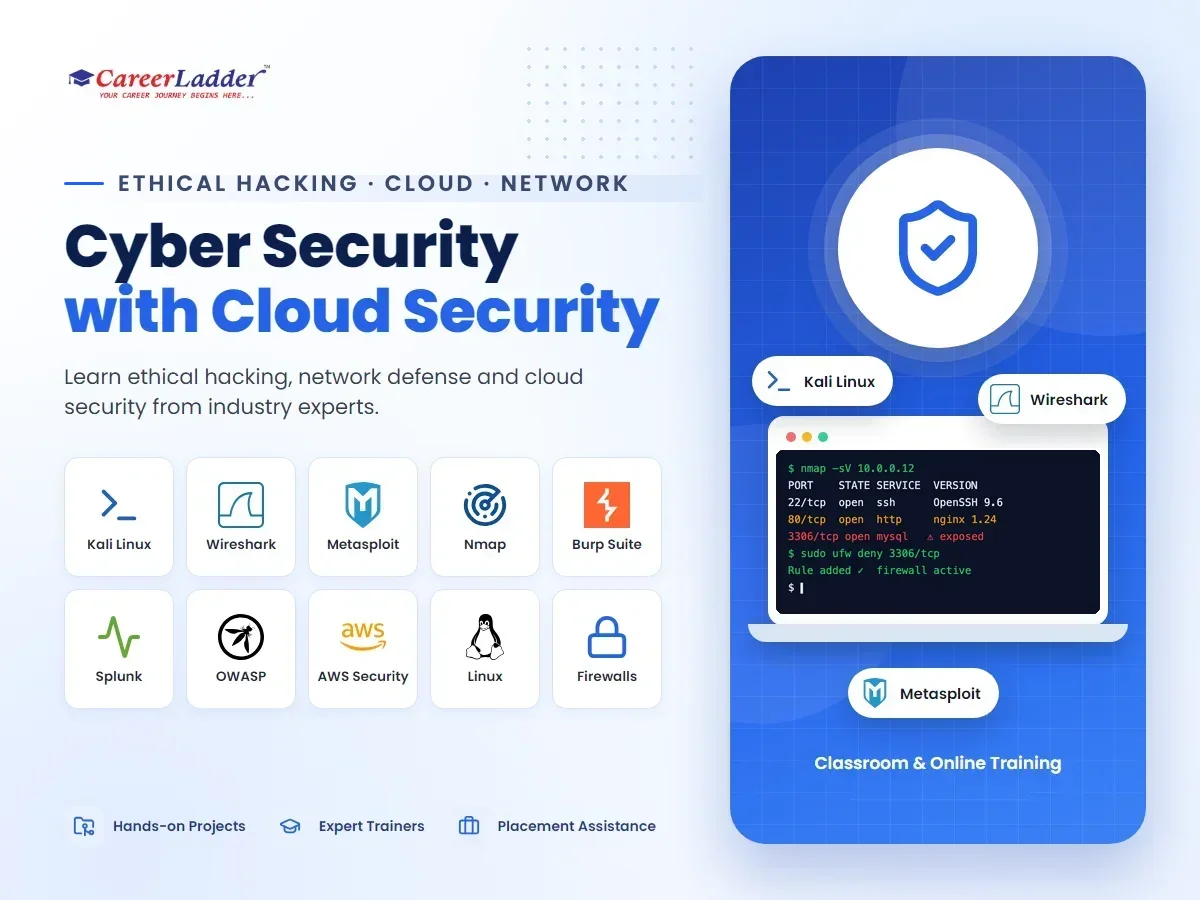
The course is deliberately hands-on. Rather than memorising definitions, you spend most of your time in labs using the tools working professionals rely on every day: Kali Linux for penetration testing, Wireshark for traffic analysis, Nmap for reconnaissance, Metasploit for exploitation, Burp Suite for web application testing, and Splunk for log analysis in a SOC context. You configure firewalls, harden Linux servers, analyse malware behaviour in sandboxes, and secure cloud environments on AWS. By working through realistic scenarios, you build the muscle memory that hiring managers look for.
Coimbatore's growing IT footprint makes this a practical time to enter the field. With technology parks such as TIDEL Park and campuses like KGISL, and with large employers including Cognizant, TCS, and Bosch operating in and around the city, demand for security-aware professionals is climbing. The region's manufacturing digitisation drive, connecting factory floors to networks and cloud dashboards, has also created a fresh appetite for people who understand operational technology security. Career Ladder trains you for these local opportunities as well as the broader Indian and remote-work market.
The programme is designed for learners at different starting points. If you have a networking or Linux background, you will accelerate quickly. If you are newer, the early modules build the networking, operating system, and scripting foundations you need before moving into offensive and defensive techniques. Career Ladder runs the course at both its Coimbatore branches (Hope College on Avinashi Road in Peelamedu and Sundarapuram) and online, so you can choose classroom or remote learning. With a 4.6-star rating across more than 1,500 Google reviews and over 10,000 students trained, the institute pairs technical depth with placement assistance including resume building, mock interviews, and hiring-partner referrals.
Course Syllabus
Module-by-module curriculum — expand each to see the topics covered.
Module 1:Cyber Security Foundations+
- The CIA triad: confidentiality, integrity, availability
- Threat landscape, attack vectors, and the cyber kill chain
- Types of attackers and common attack motivations
- Security policies, governance, and risk basics
- Overview of security roles: analyst, pentester, SOC, cloud security
Module 2:Networking and Linux Essentials for Security+
- TCP/IP model, ports, protocols, and packet flow
- Subnetting, NAT, DNS, DHCP, and routing fundamentals
- Linux command line, file permissions, and users
- Bash scripting basics for security tasks
- Network devices, firewalls, and segmentation
Module 3:Reconnaissance and Scanning+
- Passive and active information gathering (OSINT)
- Footprinting domains, IPs, and services
- Network scanning and host discovery with Nmap
- Service and version enumeration
- Vulnerability scanning concepts and tools
Module 4:Ethical Hacking Basics and Exploitation+
- Ethics, scope, and legal boundaries of pentesting
- Exploitation workflow with Metasploit Framework
- Password attacks: brute force, dictionary, hashing
- Privilege escalation on Linux and Windows
- Post-exploitation and reporting fundamentals
Module 5:Web Application Security+
- OWASP Top 10 vulnerabilities explained
- SQL injection, XSS, and CSRF hands-on
- Intercepting and manipulating traffic with Burp Suite
- Authentication and session management flaws
- Secure coding and remediation basics
Module 6:Network Traffic Analysis and Cryptography+
- Capturing and inspecting packets with Wireshark
- Detecting suspicious traffic patterns
- Symmetric and asymmetric encryption
- Hashing, digital signatures, and certificates
- TLS/SSL, VPNs, and secure communication
Module 7:Cloud Security (AWS-focused)+
- Shared responsibility model in the cloud
- IAM: users, roles, policies, and least privilege
- Securing storage, networks, and compute (S3, VPC, EC2)
- Encryption, key management, and secrets handling
- Cloud logging, CloudTrail, and misconfiguration detection
Module 8:Security Operations Centre (SOC) Skills+
- SOC tiers, roles, and daily workflow
- Log collection and SIEM concepts
- Hands-on with Splunk: searches, dashboards, alerts
- Incident detection, triage, and escalation
- Threat intelligence and MITRE ATT&CK framework
Module 9:Incident Response and Digital Forensics+
- Incident response lifecycle and playbooks
- Evidence collection and chain of custody
- Basic disk and memory forensics
- Malware behaviour analysis in a sandbox
- Post-incident review and reporting
Module 10:Compliance, Career Prep, and Certifications+
- Overview of ISO 27001, GDPR, and Indian data protection context
- Mapping skills to CEH, CompTIA Security+, and AWS Security
- Building a security portfolio and lab writeups
- Interview preparation and common scenario questions
- Resume building and hiring-partner referrals
Who Should Join This Course
Real-World Projects You Will Build
- 1Conduct a full penetration test on a deliberately vulnerable virtual machine, from reconnaissance and scanning through exploitation, and produce a professional findings report.
- 2Harden a Linux server by configuring firewalls, disabling unnecessary services, enforcing strong authentication, and documenting the baseline.
- 3Secure an AWS environment: set up least-privilege IAM policies, lock down S3 storage, configure VPC security groups, and enable CloudTrail logging.
- 4Build a mini SOC workflow in Splunk that ingests logs, creates detection dashboards, and raises alerts for suspicious login activity.
- 5Perform a web application security assessment using Burp Suite, identifying OWASP Top 10 issues like SQL injection and XSS, then recommend fixes.
- 6Analyse a captured network traffic file in Wireshark to identify a simulated attack and reconstruct the attacker's actions in an incident report.
Career Scope & Opportunities
Cyber security is one of the most resilient career paths in technology because the threat never stops evolving. Completing this course opens doors to roles such as Security Analyst, SOC Analyst, Cloud Security Engineer, Penetration Tester, and Information Security Associate. Many professionals begin in a SOC or analyst role, where they monitor and respond to threats, and then specialise in offensive security, cloud security, or governance and compliance as they gain experience.
In the Indian market, entry-level security roles typically pay in a range broadly comparable to other specialised IT jobs, and compensation tends to rise steeply with hands-on experience and certifications. As a rough guide, freshers commonly start in the region of a few lakhs per annum, while experienced analysts and cloud security engineers can earn substantially more; actual figures vary widely by employer, city, and skill depth, so treat any number as indicative rather than a promise.
Coimbatore's expanding IT services base and its manufacturing digitisation give local graduates a genuine advantage. Companies operating in and around the city, along with the many organisations hiring remotely across India, need people who can secure cloud deployments and monitor increasingly connected environments. Security roles also travel well: the skills you build here are recognised globally and support remote and relocation opportunities alike.
Career Ladder supports your transition with placement assistance that includes resume building, mock interviews focused on real security scenarios, and referrals to hiring partners. Combined with a hands-on portfolio of lab writeups and project reports, this preparation helps you present as job-ready rather than merely certified.
What You Will Master
100% Placement Assistance
Resume building, mock interviews, and direct referrals to our hiring partners — until you land the role.
Frequently Asked Questions
Do I need coding for Cyber Security and Cloud Security?+
Basic knowledge of networking and Linux is helpful. We teach Python for security scripting and cloud configuration from scratch.
What certifications are covered?+
We cover the syllabus for CEH (Certified Ethical Hacker), AWS Certified Security Specialty, and CompTIA Security+.
Is there placement support for security roles?+
Yes, we provide 100% placement assistance for roles like Security Analyst, Cloud Security Engineer, and SOC Analyst.
How is cloud security different from traditional cyber security?+
Traditional cyber security focuses on protecting on-premises networks, servers, and endpoints. Cloud security applies those principles to cloud platforms like AWS, where you also deal with the shared responsibility model, identity and access management, misconfiguration risks, and cloud-native logging. This course covers both so you can work across on-premises and cloud environments.
Will I learn to use real hacking tools in the labs?+
Yes. You work hands-on with industry tools including Kali Linux, Nmap, Metasploit, Wireshark, Burp Suite, and Splunk in controlled lab environments. All offensive techniques are taught strictly for ethical, defensive, and authorised testing purposes.
What is a SOC analyst, and does this course prepare me for that role?+
A Security Operations Centre (SOC) analyst monitors systems for threats, investigates alerts, and responds to incidents. The course includes dedicated SOC modules with hands-on Splunk work, incident triage, and the MITRE ATT&CK framework, which are directly relevant to entry-level SOC roles.
Do I need to be good at programming to succeed in cyber security?+
Deep programming is not required to start, but comfort with scripting helps. We teach the Bash and basic scripting you need for security tasks, along with the Linux and networking foundations. Logical thinking and curiosity matter more than advanced coding at the entry level.
Can I take this course while working full time?+
Yes. Career Ladder offers both classroom training at the Hope College and Sundarapuram branches in Coimbatore and online options, so you can choose a format that fits your schedule as a working professional.
Our Coimbatore Branches
Hope College (Peelamedu)
1st Floor, 267, Avinashi Road, Peelamedu (Hope College), Opposite GRG Ladies Hostel, Above Sneha Hospital, Coimbatore 641004
+91 88702 75880
Sundarapuram
1st Floor, Bank of Baroda Building, 5, Madukkarai Main Rd, opp. Abirami Hospital, Sundarapuram, Coimbatore
+91 88070 28071