Embedded Systems Course in Coimbatore
Master IoT, Hardware Programming, and Real-Time Systems with Industry Experts
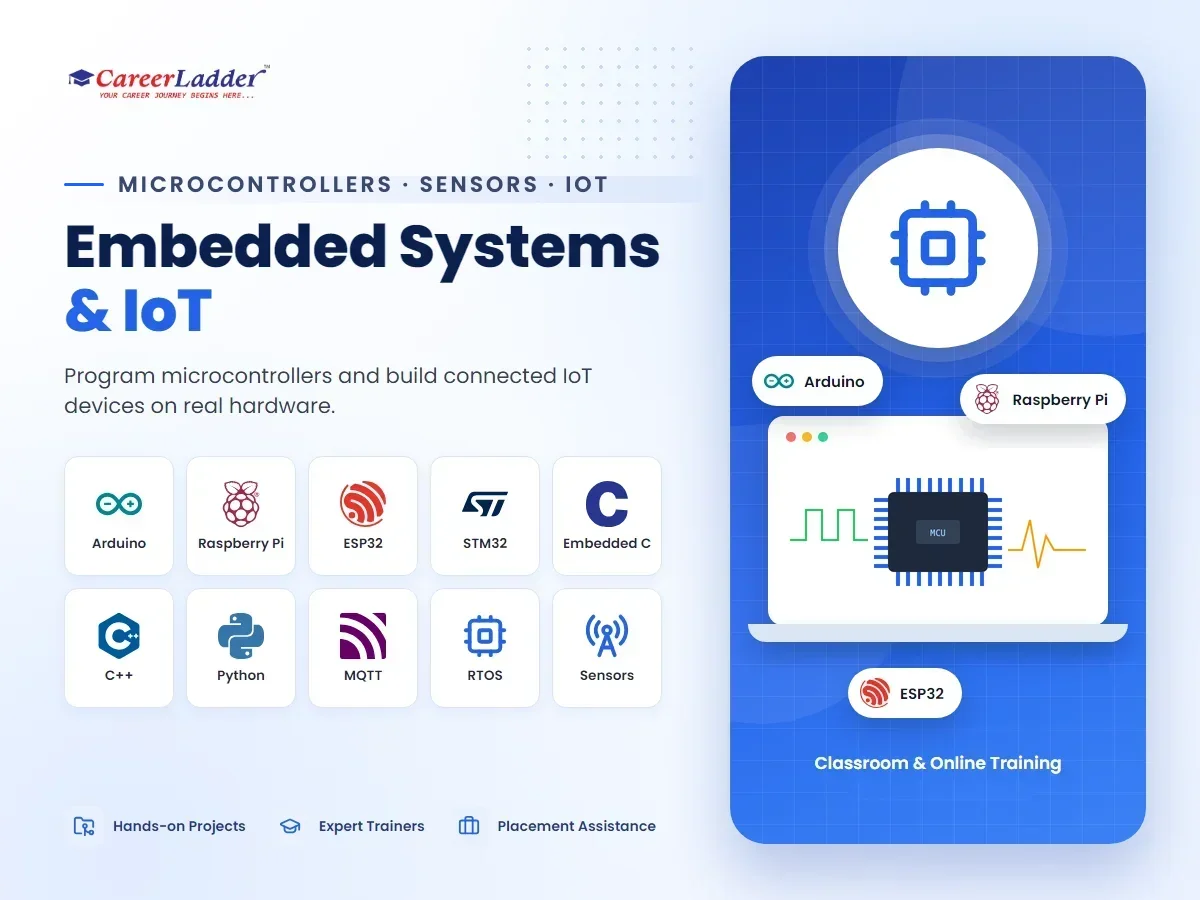
About the Embedded Systems & IoT Course
Learn the foundations of embedded systems, IoT, and hardware programming.
Train at our Avinashi Road (Hope College, Peelamedu) or Sundarapuram branch in Coimbatore — or join online — with hands-on projects, industry mentors, and dedicated placement support from day one.
Embedded systems are the invisible computers inside everything that switches, senses, or moves — washing machines, EV chargers, medical monitors, motor drives, and smart water pumps. The Embedded Systems & IoT course at Career Ladder takes you from digital electronics fundamentals to writing production-style firmware in Embedded C on 8051, PIC, AVR, and ARM Cortex-M microcontrollers. You will spend most of your time at the bench: flashing boards, reading datasheets, debugging with a logic analyzer mindset, and making real hardware respond to real code.
The curriculum is structured as a progression. You begin with C programming the way firmware engineers actually use it — pointers, bit manipulation, memory-mapped registers, and volatile-qualified peripheral access. From there you move into microcontroller architecture, peripheral programming (GPIO, timers, ADC, PWM, interrupts), and the serial communication protocols that connect chips to each other: UART, I2C, SPI, and CAN. The later modules add FreeRTOS task-based design and the IoT layer — MQTT, HTTP, and cloud integration with platforms such as AWS IoT — so you can build devices that both control hardware locally and report to the cloud.
Coimbatore is an unusually good city to learn this in. Known as the Manchester of South India, the region is dense with pump, motor, textile-machinery, and auto-component manufacturers, and a growing cluster of product startups building IoT retrofits for exactly those machines. Firmware talent that understands both a motor and an MQTT broker is genuinely scarce here, and Career Ladder positions the course around that gap. Training runs in classroom mode at our Hope College (Avinashi Road, Peelamedu) and Sundarapuram branches, with a live online option for learners outside the city.
Career Ladder has trained more than 10,000 students and holds a 4.6-star rating across 1,500+ Google reviews. Every embedded batch includes placement assistance — resume building targeted at core-electronics roles, mock technical interviews covering C and microcontroller questions, and referrals to hiring partners in the automotive, consumer electronics, and industrial IoT space.
Course Syllabus
Module-by-module curriculum — expand each to see the topics covered.
Module 1:C Programming for Firmware+
- Data types, operators, and control flow refresher
- Pointers, arrays, and pointer arithmetic
- Structures, unions, and bit-fields for register maps
- Bitwise operations: masking, setting, toggling flags
- volatile, const, and static in embedded contexts
- Memory layout: stack, heap, .bss, .data, and linker basics
Module 2:Digital Electronics & Microcontroller Architecture+
- Number systems, logic gates, and flip-flops
- Microprocessor vs microcontroller vs SoC
- 8051 and AVR architecture walkthrough
- ARM Cortex-M core: registers, NVIC, and bus structure
- Clock trees, reset circuits, and power supply basics
- Reading datasheets and reference manuals effectively
Module 3:Peripheral Programming on ARM Cortex-M (STM32)+
- GPIO configuration and driving LEDs, relays, and buzzers
- Timers, counters, and PWM for motor and LED control
- ADC and DAC: sampling sensors and generating signals
- Interrupts, priorities, and writing safe ISRs
- Watchdog timers and low-power sleep modes
- STM32CubeIDE and HAL vs bare-register programming
Module 4:Serial Communication Protocols+
- UART framing, baud rates, and interrupt-driven drivers
- I2C: addressing, clock stretching, and multi-device buses
- SPI: modes, chip-select handling, and high-speed transfers
- CAN bus fundamentals for automotive and industrial nodes
- Interfacing EEPROMs, RTC chips, and OLED displays
- Protocol debugging with serial monitors and analyzers
Module 5:Sensors, Actuators & Interfacing+
- Temperature, humidity, ultrasonic, and IMU sensors
- Signal conditioning: pull-ups, dividers, and level shifting
- Relay boards, motor drivers (L298N, DRV series), and servos
- Rotary encoders and speed/position feedback
- Keypads, LCDs, and seven-segment multiplexing
- Prototyping on Arduino and migrating designs to STM32
Module 6:RTOS Fundamentals with FreeRTOS+
- Why an RTOS: super-loop limits and task-based design
- Tasks, priorities, and the FreeRTOS scheduler
- Queues, semaphores, and mutexes for inter-task communication
- Priority inversion, deadlock, and stack sizing
- Software timers and event groups
- Structuring a multi-task firmware project
Module 7:IoT Connectivity & Cloud Integration+
- ESP32 Wi-Fi programming and station/AP modes
- MQTT: brokers, topics, QoS levels, and retained messages
- HTTP/REST APIs from constrained devices
- AWS IoT Core: things, certificates, and device shadows
- Dashboards and alerts from live sensor streams
- OTA firmware update concepts and device security basics
Module 8:Raspberry Pi & Edge Applications+
- Linux command line and Python for the Pi
- GPIO control and camera interfacing
- Serial bridging between Pi and microcontrollers
- Edge data logging and local dashboards
- When to choose MCU vs embedded Linux in a product
Module 9:Simulation, Debugging & Capstone+
- Proteus circuit simulation and Keil uVision workflows
- On-chip debugging: breakpoints, watch windows, SWD
- Version control for firmware teams with Git
- Capstone: end-to-end IoT product build and demo
- Documentation, test reports, and interview portfolio prep
Who Should Join This Course
Real-World Projects You Will Build
- 1Smart energy monitor: an STM32-based meter that samples voltage and current, computes power consumption, and publishes readings to AWS IoT over MQTT with a live dashboard.
- 2Industrial pump-condition monitor: vibration and temperature sensing on a motor-pump rig with threshold alarms, local LCD display, and cloud alerting — a use case straight out of Coimbatore pump industry.
- 3CAN-based vehicle sub-network: multiple microcontroller nodes exchanging sensor and actuator messages over CAN, simulating an automotive body-control setup.
- 4FreeRTOS home-automation hub: a multi-task ESP32 firmware managing relays, sensor polling, an OLED UI, and MQTT commands concurrently without blocking.
- 5RFID attendance and access system: card reading, EEPROM storage, buzzer/relay door control, and a Raspberry Pi backend that logs entries to a database.
- 6Capstone IoT product: your own device concept taken from breadboard prototype to enclosure-ready build, with schematic, firmware repository, and demo video for interviews.
Career Scope & Opportunities
Embedded roles you can target after this course include Embedded Software Engineer, Firmware Developer, IoT Engineer, Embedded Testing Engineer, and Hardware-Software Integration Engineer. Demand comes from automotive electronics, consumer appliances, medical devices, industrial automation, and the fast-growing EV and smart-metering segments — all areas where India is expanding local design and manufacturing.
Coimbatore-specific demand is a real advantage. The city and its industrial belt host hundreds of pump, motor, compressor, and textile-machinery manufacturers, many of which are adding electronics, VFD control, and IoT monitoring to traditionally mechanical products. Alongside them sit electronics design services firms and startups building agri-tech, energy-monitoring, and machine-retrofit products. These employers hire locally for firmware and IoT roles, and nearby hubs like Chennai and Bengaluru widen the market further for automotive and semiconductor-adjacent positions.
On compensation, entry-level embedded engineers in India typically see offers in the broad range of about 3–6 LPA depending on company type and interview depth, with product companies paying more than services. Engineers with 3–5 years of solid firmware experience commonly move into the 8–18 LPA band, and specialists in RTOS, automotive (AUTOSAR), or wireless stacks can go higher. Treat these as indicative market ranges — actual offers vary by city, employer, and skill evidence.
The durable career logic is this: embedded skills compound. C, register-level thinking, and debugging discipline transfer across every chip vendor and industry, and the IoT layer keeps pulling device programmers toward higher-value system roles. Career Ladder placement assistance — resume building, mock interviews, and hiring-partner referrals — is geared to converting your project portfolio into those first core-domain interviews.
What You Will Master
100% Placement Assistance
Resume building, mock interviews, and direct referrals to our hiring partners — until you land the role.
Frequently Asked Questions
Do I need an electronics background?+
A basic understanding of electronics is helpful, but we start with the fundamentals of digital electronics and C programming.
What hardware will I work on?+
You will get hands-on experience with Arduino, Raspberry Pi, STM32, and various sensors and actuators.
Is there placement support for core engineering?+
Yes, we have a dedicated core-placement cell that connects you with companies in Automotive, Consumer Electronics, and IoT sectors.
How is this course different from a college microprocessors subject?+
College courses usually stop at theory and a few 8051 lab experiments. Here you write, flash, and debug real firmware on modern ARM Cortex-M boards, build complete projects with sensors and cloud connectivity, and learn the tooling — IDEs, debuggers, Git — that companies expect on day one.
Do I need to buy my own hardware kits?+
Classroom students use the lab hardware at our branches — Arduino, STM32, ESP32, Raspberry Pi, and sensor kits are provided. Online learners are guided on a low-cost starter kit they can buy locally so every session stays hands-on.
Which is more important for jobs: Arduino skills or ARM/STM32 skills?+
Arduino is a great learning bridge, but employers hire on ARM-class skills — register-level programming, interrupts, RTOS, and protocol drivers on STM32-type controllers. The course uses Arduino early for speed, then deliberately moves you to STM32 and FreeRTOS for job readiness.
Will this course help me get into IoT product startups?+
Yes. The IoT modules cover exactly the stack small product teams use — ESP32, MQTT, cloud dashboards, and OTA concepts — and your capstone is a complete device you can demo. Startups in and around Coimbatore value candidates who can show a working end-to-end build.
Can a mechanical engineering graduate take this course?+
Yes, with commitment. We start from digital electronics and C fundamentals, so mechanical and mechatronics graduates regularly succeed, especially those targeting IoT, EV, and machine-automation roles where mechanical intuition plus firmware skills is a strong combination.
Our Coimbatore Branches
Hope College (Peelamedu)
1st Floor, 267, Avinashi Road, Peelamedu (Hope College), Opposite GRG Ladies Hostel, Above Sneha Hospital, Coimbatore 641004
+91 88702 75880
Sundarapuram
1st Floor, Bank of Baroda Building, 5, Madukkarai Main Rd, opp. Abirami Hospital, Sundarapuram, Coimbatore
+91 88070 28071
Related Courses
PLC SCADA
Master industrial automation with hands-on training in PLC programming and SCADA systems.
AutoCAD Electrical
Master electrical design and drafting with AutoCAD Electrical for industrial applications.
PCB Design
Master circuit design, schematic capture, and layout using industry-standard PCB tools.