PLC SCADA Training in Coimbatore
Master Industrial Automation, PLC Programming, and SCADA Systems with Real-Time Projects
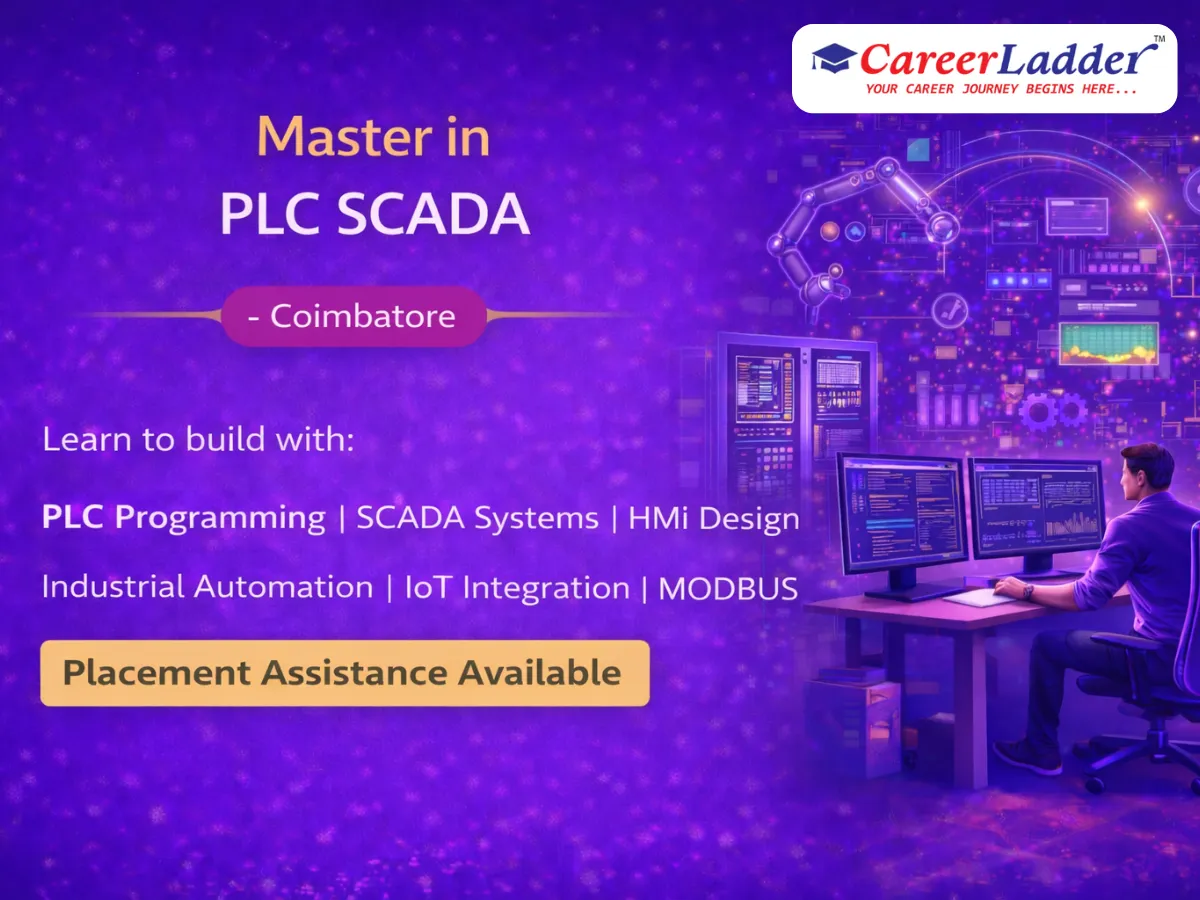
About the PLC SCADA Course
Master industrial automation with hands-on training in PLC programming and SCADA systems.
Train at our Avinashi Road (Hope College, Peelamedu) or Sundarapuram branch in Coimbatore — or join online — with hands-on projects, industry mentors, and dedicated placement support from day one.
Walk into any modern factory around Coimbatore — a pump foundry in Sundarapuram, a textile mill on Avinashi Road, an auto-component plant near the SIDCO estates — and the machines are run by PLCs, watched over by SCADA screens, and operated through HMIs. The PLC SCADA course at Career Ladder trains you to be the engineer who programs, commissions, and troubleshoots those systems. It is a practice-first program: you wire panels, write ladder logic on real controllers, design operator screens, and simulate full plant sequences before you ever face one on the job.
The syllabus follows the way automation projects actually unfold. It opens with electrical control fundamentals — relays, contactors, motor starters, and control-panel wiring — because every PLC program ultimately drives real switchgear. You then learn PLC programming in depth across ladder logic, function block diagram, and structured text, working on industry-dominant platforms in the Siemens and Allen-Bradley families. Later modules cover analog process control, VFD-based motor speed control, HMI screen design, SCADA architecture with alarming and data logging, and industrial communication networks such as Modbus and PROFINET.
Few Indian cities reward this skill set like Coimbatore does. The Manchester of South India runs on motors and machinery: pump and wet-grinder manufacturers, spinning and weaving units, compressor makers, CNC job shops, and food-processing plants all depend on automation engineers to keep lines running and to execute upgrade projects. System integrators serving these factories hire steadily, and maintenance teams inside the plants constantly need people who can read a ladder program at 2 a.m. when production stops. This course is built to make you that person.
You can attend in classroom mode at either Career Ladder branch — Hope College in Peelamedu or Sundarapuram — or join the live online track. The institute has trained over 10,000 students, carries a 4.6-star rating from 1,500+ Google reviews, and backs every automation batch with placement assistance: automation-focused resume preparation, mock interviews built around wiring and logic scenarios, and referrals to hiring partners including local integrators and manufacturers.
Course Syllabus
Module-by-module curriculum — expand each to see the topics covered.
Module 1:Industrial Electrical & Control Basics+
- AC/DC fundamentals, single-phase and three-phase power
- Relays, contactors, overload relays, and timers
- Motor starters: DOL and star-delta control circuits
- Push buttons, selector switches, limit switches, and indicators
- Reading and drawing basic control wiring diagrams
- Panel safety: fuses, MCBs, earthing, and interlocks
Module 2:PLC Architecture & Wiring+
- What a PLC is: CPU, power supply, I/O modules, and racks
- Digital and analog I/O: sinking vs sourcing, wiring practices
- Scan cycle: input read, logic solve, output update
- Addressing schemes across Siemens and Allen-Bradley platforms
- Field-device wiring: sensors, proximity switches, encoders
- Compact vs modular PLCs and selecting hardware for a job
Module 3:Ladder Logic Programming — Core+
- NO/NC contacts, coils, and rung logic
- Latching, interlocking, and sequence control
- Timers: ON-delay, OFF-delay, and retentive types
- Counters: up, down, and cascading for batch counts
- Comparison and math instructions
- Simulating and testing logic before download
Module 4:Advanced PLC Programming+
- Data types, memory organization, and move/copy instructions
- Function Block Diagram (FBD) and Structured Text (ST) basics
- Subroutines, functions, and reusable program blocks
- Shift registers and sequencers for conveyor tracking
- Fault handling, diagnostics buffers, and forcing I/O safely
- Online editing, uploads, downloads, and program backups
Module 5:Analog Signals & Process Control+
- Analog standards: 0-10 V, 4-20 mA, and RTD/thermocouple inputs
- Scaling raw counts to engineering units
- Level, pressure, flow, and temperature measurement
- PID control concepts and tuning a loop on a PLC
- Closed-loop tank-level and temperature exercises
Module 6:Motor Control with VFDs+
- Variable Frequency Drive working principle
- Drive parameterization: ramps, limits, and protection settings
- Controlling a VFD from PLC digital and analog outputs
- Speed control applications: pumps, fans, and conveyors
- Energy-saving logic for pump and blower applications
Module 7:HMI Design & Operator Interfaces+
- HMI hardware and software overview
- Screen design: buttons, numeric entries, and status displays
- Tag linking between HMI and PLC
- Alarm displays, recipes, and user access levels
- Good operator-UX practices for shop-floor screens
Module 8:SCADA Systems+
- SCADA architecture: field devices, RTUs/PLCs, servers, clients
- Building SCADA screens and animating live plant graphics
- Trends, historical data logging, and reports
- Alarm management and event handling
- Scripting basics for SCADA applications
- Redundancy and security considerations in plant SCADA
Module 9:Industrial Communication Networks+
- RS-232/RS-485 and serial communication fundamentals
- Modbus RTU and Modbus TCP configuration
- PROFINET and Ethernet/IP concepts
- PLC-to-PLC and PLC-to-SCADA connectivity labs
- Introduction to IIoT gateways and Industry 4.0 data flows
Module 10:Project Engineering & Capstone+
- Reading P&IDs and automation project documents
- I/O list preparation and control philosophy writing
- Panel testing, commissioning steps, and troubleshooting method
- Capstone: automate a complete process line with PLC, HMI, and SCADA
- Interview preparation with real fault-finding scenarios
Who Should Join This Course
Real-World Projects You Will Build
- 1Automatic water-pumping station: level-sensor-driven pump control with dry-run protection, duty-standby pump alternation, and an HMI showing tank levels — modeled on real municipal and industrial pumping skids.
- 2Bottle-filling and capping line: sensor-based bottle detection, conveyor sequencing, fill timing, reject handling, and production counting programmed in ladder logic.
- 3Textile-machine sequence automation: multi-motor start/stop interlocks, tension-related speed coordination using VFDs, and fault annunciation reflecting spinning-mill requirements.
- 4Temperature-controlled process tank: 4-20 mA transmitter input, PID heating control, high/low alarms, and trend logging in SCADA.
- 5Traffic and material-handling control: junction-style sequencing plus a conveyor sorting exercise using timers, counters, and shift registers.
- 6Capstone mini-plant: integrate PLC logic, VFD motor control, HMI screens, Modbus communication, and a SCADA station into one working process demo you can explain end-to-end in interviews.
Career Scope & Opportunities
Typical roles after PLC SCADA training include Automation Engineer, PLC Programmer, Controls & Instrumentation Engineer, Service/Commissioning Engineer, SCADA Engineer, and Plant Maintenance Engineer. Employers span three groups: system integrators who execute automation projects, machine builders (OEMs) who ship PLC-controlled equipment, and end-user factories that run and maintain those systems.
In and around Coimbatore, all three groups are thriving. The district is one of India’s largest clusters for pumps, motors, wet grinders, castings, and textile machinery, and every one of those product lines is getting more automated — from VFD-driven energy retrofits to fully sequenced production cells. Local integrators regularly recruit trained freshers for panel testing, programming, and site commissioning, while mills and foundries hire automation-literate maintenance engineers to reduce downtime. Commissioning roles also open doors to project travel across India and the Gulf.
Indicative India-market compensation: fresh automation engineers commonly start around 2.5–4.5 LPA, service and commissioning engineers with 2–4 years of site experience often reach 5–9 LPA, and senior controls engineers or project leads with strong Siemens/Rockwell depth can command 10–20 LPA, with international site postings paying substantially more. These are hedged market ranges, not guarantees — offers depend on employer, platform expertise, and hands-on credibility.
Automation is also one of the most future-proof core-engineering tracks: Industry 4.0, IIoT dashboards, and energy-efficiency mandates all increase the amount of PLC and SCADA work rather than replacing it. Career Ladder supports your entry with placement assistance — a project-backed resume, mock interviews featuring live fault-finding questions, and referrals to hiring partners in the regional manufacturing ecosystem.
100% Placement Assistance
Resume building, mock interviews, and direct referrals to our hiring partners — until you land the role.
Frequently Asked Questions
What is PLC SCADA?+
PLC (Programmable Logic Controller) and SCADA (Supervisory Control and Data Acquisition) are crucial technologies for industrial automation, controlling and monitoring machinery in various industries.
Do I need an engineering background?+
A background in Electrical, Electronics, or Instrumentation Engineering is beneficial, but we cover the fundamentals from scratch.
Is this course hands-on?+
Absolutely. You will work on live industrial setups, program PLCs, design HMIs, and configure SCADA systems.
Which PLC brands will I actually practice on?+
Training centers on the platforms that dominate Indian industry — the Siemens family (TIA Portal environment) and Allen-Bradley/Rockwell — with exposure to Delta/Mitsubishi-class compact PLCs that are common in Coimbatore machine-builder segments. The programming concepts transfer across brands once you know two ecosystems well.
Can I get automation jobs in Coimbatore itself, or will I have to relocate?+
Coimbatore has genuine local demand — system integrators, pump and motor OEMs, textile mills, and foundries in the district hire automation and maintenance engineers regularly. Relocation widens options (Chennai, Bengaluru, Gulf projects), but it is not mandatory the way it often is for niche IT roles.
How much math or programming do I need before joining?+
Very little. Ladder logic is closer to electrical relay thinking than to software coding, and the math involved is arithmetic plus basic scaling. If you can read a simple control wiring diagram — or are willing to learn in the first module — you can handle this course.
Does the course cover VFDs and drives, or only PLC logic?+
Both. A dedicated module covers VFD principles, parameter setting, and controlling drives from the PLC, because most real projects — especially pump, fan, and conveyor applications common in this region — combine PLC logic with drive-based motor control.
Is SCADA still relevant with Industry 4.0 and IIoT coming in?+
Yes — IIoT builds on top of SCADA rather than replacing it. Plants still need supervisory control, alarming, and historians; Industry 4.0 adds cloud analytics above that layer. The course covers Modbus/Ethernet connectivity and IIoT gateway concepts so you understand how both worlds connect.
Our Coimbatore Branches
Hope College (Peelamedu)
1st Floor, 267, Avinashi Road, Opposite GRG Ladies Hostel, Above Sneha Hospital, Hope College, Coimbatore 641004
+91 88702 75880
Sundarapuram
1st Floor, Bank of Baroda Building, 5, Madukkarai Main Rd, opp. Abirami Hospital, Sundarapuram, Coimbatore
+91 88070 28071
Related Courses
Embedded Systems & IoT
Learn the foundations of embedded systems, IoT, and hardware programming.
AutoCAD Electrical
Master electrical design and drafting with AutoCAD Electrical for industrial applications.
PCB Design
Master circuit design, schematic capture, and layout using industry-standard PCB tools.