DevOps Course in Coimbatore
Master Cloud Automation, CI/CD, and Infrastructure as Code with Job-Oriented Training
About the DevOps Engineering Course
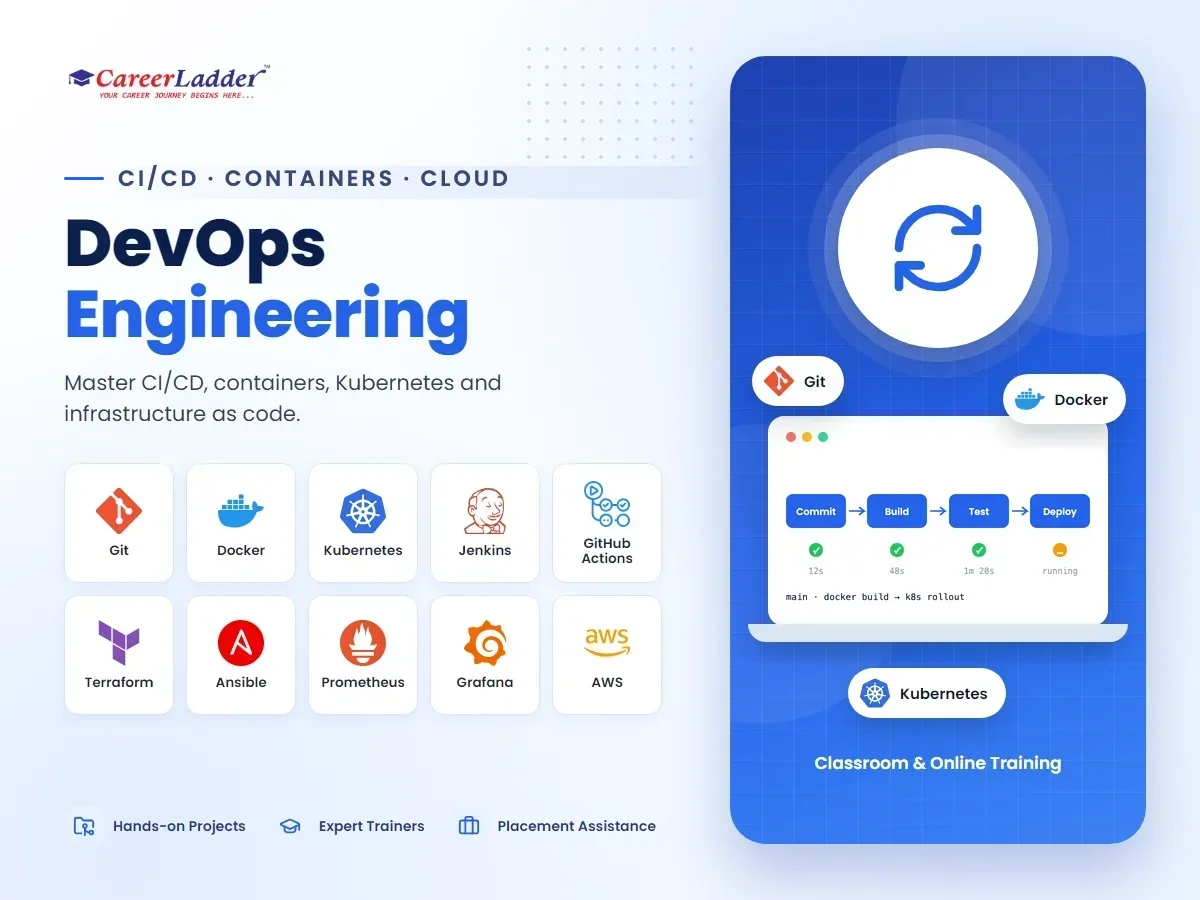
Master Docker, Kubernetes, Jenkins, and Cloud CI/CD pipelines to streamline software delivery.
Train at our Avinashi Road (Hope College, Peelamedu) or Sundarapuram branch in Coimbatore — or join online — with hands-on projects, industry mentors, and dedicated placement support from day one.
DevOps is the practice that lets modern software teams ship changes safely, quickly, and repeatedly, and the DevOps Engineering course at Career Ladder trains you to build the automation that makes this possible. Where a cloud course teaches you how infrastructure works, this programme is about the pipeline: how code moves from a developer's laptop into production reliably, how environments are built with a single command, and how running systems are monitored and healed. You learn to remove the manual, error-prone steps between writing code and delivering value.
The course centres on the DevOps toolchain that companies actually use. You start with Git for version control and collaboration, then containerise applications with Docker so they run identically everywhere. You orchestrate those containers at scale with Kubernetes, automate builds and deployments with Jenkins and GitHub Actions, define infrastructure declaratively with Terraform, and manage configuration with Ansible. Finally, you close the loop with monitoring and observability using Prometheus and Grafana, so you can see and respond to what your systems are doing in real time.
What sets this apart from a pure cloud course is its relentless focus on automation and continuous delivery. You will design and build CI/CD pipelines end to end: a commit triggers automated tests, builds a container image, pushes it to a registry, and deploys it to a Kubernetes cluster, all without manual intervention. You will practise the cultural and technical habits, such as infrastructure as code, immutable deployments, and automated rollbacks, that define high-performing engineering teams.
Coimbatore's technology ecosystem makes DevOps skills highly relevant here. Software companies operating around TIDEL Park and KGISL, along with large employers such as Cognizant, TCS, and Bosch, increasingly rely on continuous delivery to stay competitive, and the region's manufacturing digitisation is creating new pipelines for connected systems and data. Career Ladder offers the course in classroom mode at its Hope College (Peelamedu, Avinashi Road) and Sundarapuram branches as well as online. With a 4.6-star rating across more than 1,500 Google reviews and over 10,000 students trained, the institute combines practical DevOps training with placement assistance including resume building, mock interviews, and hiring-partner referrals.
Course Syllabus
Module-by-module curriculum — expand each to see the topics covered.
Module 1:DevOps Culture and Fundamentals+
- What DevOps is and the problems it solves
- The software delivery lifecycle and bottlenecks
- CI/CD, continuous delivery, and continuous deployment
- The DevOps toolchain overview
- Agile, collaboration, and shared ownership
Module 2:Linux and Scripting for DevOps+
- Linux administration essentials
- Shell scripting for automation
- Package management and services
- Users, permissions, and process management
- Introduction to Python for automation tasks
Module 3:Version Control with Git+
- Git fundamentals: commits, branches, merges
- Branching strategies (Git Flow, trunk-based)
- Pull requests and code review workflows
- Resolving conflicts and rewriting history
- GitHub and GitLab collaboration
Module 4:Containerisation with Docker+
- Containers versus virtual machines
- Building images with Dockerfiles
- Managing containers, volumes, and networks
- Docker Compose for multi-container apps
- Image registries and best practices
Module 5:Container Orchestration with Kubernetes+
- Kubernetes architecture and components
- Pods, deployments, services, and namespaces
- ConfigMaps, secrets, and volumes
- Scaling, rolling updates, and self-healing
- Ingress, Helm charts, and cluster basics
Module 6:Continuous Integration and Delivery+
- Building pipelines with Jenkins
- Declarative pipelines and Jenkinsfiles
- GitHub Actions workflows
- Automated testing and quality gates
- Artifact management and deployment stages
Module 7:Infrastructure as Code with Terraform+
- Declarative infrastructure principles
- Terraform providers, resources, and state
- Modules, variables, and reusable code
- Provisioning cloud resources on AWS
- Managing changes and remote state safely
Module 8:Configuration Management with Ansible+
- Idempotent configuration concepts
- Playbooks, roles, and inventories
- Managing servers at scale
- Templating and secrets with Ansible Vault
- Integrating Ansible into pipelines
Module 9:Monitoring and Observability+
- Metrics, logs, and traces
- Collecting metrics with Prometheus
- Building dashboards in Grafana
- Alerting and on-call basics
- Log aggregation and troubleshooting
Module 10:End-to-End Pipeline and Career Prep+
- Designing a complete CI/CD pipeline
- Deploying a containerised app to Kubernetes automatically
- GitOps and deployment strategies (blue-green, canary)
- Security in the pipeline (DevSecOps basics)
- Interview preparation, portfolio, and referrals
Who Should Join This Course
Real-World Projects You Will Build
- 1Build a complete CI/CD pipeline in Jenkins that automatically tests, builds a Docker image, and deploys an application on every commit.
- 2Containerise a multi-service application with Docker Compose, then migrate it to run on a Kubernetes cluster with deployments and services.
- 3Write Terraform code to provision a reproducible cloud environment, including networking and compute, that can be created and destroyed on demand.
- 4Automate server configuration across multiple machines using Ansible playbooks and roles, ensuring idempotent, repeatable setup.
- 5Implement a monitoring stack with Prometheus and Grafana that collects metrics from a running application and raises alerts on failures.
- 6Set up a GitHub Actions workflow that runs tests and deploys to a staging environment using a blue-green or canary strategy.
Career Scope & Opportunities
DevOps engineers are among the most valued professionals in software organisations because they directly improve delivery speed, reliability, and cost efficiency. Completing this course prepares you for roles such as DevOps Engineer, Build and Release Engineer, Site Reliability Engineer (SRE), and CI/CD Engineer. Career progression is strong: from junior DevOps roles you can grow into platform engineering, SRE, or cloud architecture as your automation and systems expertise deepens.
In the Indian market, DevOps roles typically command salaries at the upper end of IT bands because the combination of coding, systems, and cloud skills is scarce. As a hedged, indicative guide, entry-level DevOps professionals often start in the range of a few lakhs per annum, and experienced engineers can earn significantly more; actual pay varies widely with employer, location, tool depth, and experience, so treat any specific number cautiously.
Locally, Coimbatore's product and services companies are adopting continuous delivery to compete, and the manufacturing sector's digitisation is producing more automated data and deployment pipelines that need skilled hands. Because DevOps work is largely tool- and cloud-based, it is also well suited to remote roles, widening the opportunities available to you beyond the city.
Career Ladder backs your job search with placement assistance: resume building focused on DevOps competencies, mock interviews that cover pipeline design and troubleshooting scenarios, and referrals to hiring partners. A portfolio of working pipelines, Kubernetes deployments, and infrastructure-as-code repositories makes your capabilities tangible to employers.
What You Will Master
100% Placement Assistance
Resume building, mock interviews, and direct referrals to our hiring partners — until you land the role.
Frequently Asked Questions
Do I need coding skills for DevOps?+
Basic scripting knowledge (Python/Shell) is recommended, but we cover the essentials from scratch.
What tools are covered?+
We cover Docker, Kubernetes, Jenkins, Git, Terraform, Ansible, Prometheus, and Grafana.
Is this course suitable for freshers?+
Yes, both freshers and experienced professionals (SysAdmins, Developers) can join to boost their career.
How is the DevOps course different from the cloud course?+
The cloud course teaches how AWS services work and how to architect and operate infrastructure. The DevOps course focuses on automating the software delivery pipeline: version control, containers, Kubernetes, CI/CD, infrastructure as code, and monitoring. DevOps builds on cloud knowledge but is centred on automation and continuous delivery rather than infrastructure design alone.
Do I need to be a developer to learn DevOps?+
You do not need to be an expert developer, but comfort with scripting and reading code helps a lot. We cover the Linux, shell scripting, and basic Python you need, so both developers and operations professionals can succeed.
Will I learn both Docker and Kubernetes in depth?+
Yes. You start by containerising applications with Docker and Docker Compose, then move to orchestrating them at scale with Kubernetes, covering deployments, services, scaling, self-healing, and Helm. Both are core, hands-on parts of the course.
Which CI/CD tools are covered?+
You work primarily with Jenkins and GitHub Actions to build automated pipelines, and you learn the concepts of testing gates, artifact management, and deployment strategies that carry over to other CI/CD tools like GitLab CI.
Is prior cloud knowledge required before joining?+
It is helpful but not mandatory. The course includes the cloud essentials you need to deploy to AWS, such as EC2, S3, IAM, and VPC basics. If you want a deeper cloud foundation, our AWS cloud course pairs well with this one, either before or alongside it, giving you both the infrastructure depth and the automation skills that employers increasingly expect from the same engineer.
Our Coimbatore Branches
Hope College (Peelamedu)
1st Floor, 267, Avinashi Road, Opposite GRG Ladies Hostel, Above Sneha Hospital, Hope College, Coimbatore 641004
+91 88702 75880
Sundarapuram
1st Floor, Bank of Baroda Building, 5, Madukkarai Main Rd, opp. Abirami Hospital, Sundarapuram, Coimbatore
+91 88070 28071