AI Integrated Java Full Stack Course in Coimbatore
Master Enterprise Application Development with Java, Spring Boot, React, and AI Integration
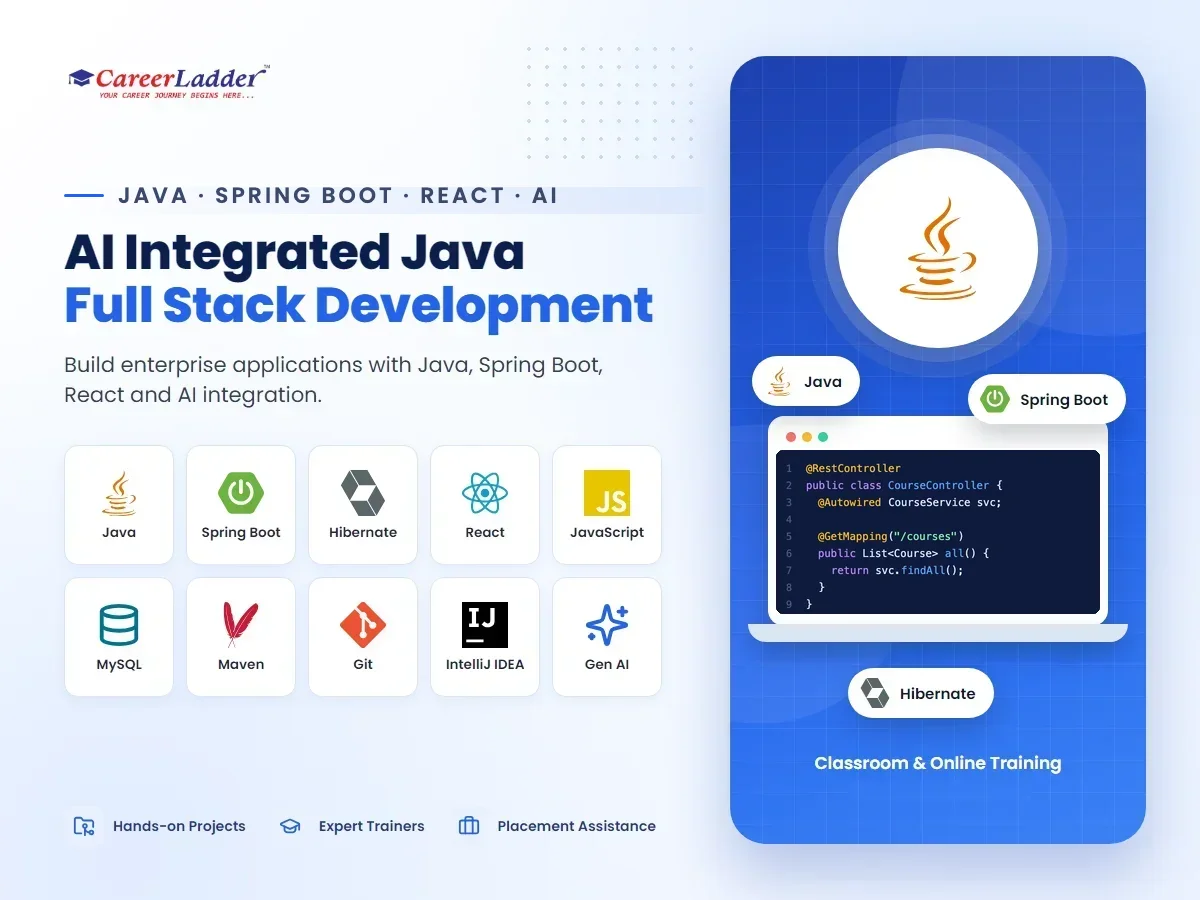
About the AI Integrated Java Full Stack Development Course
Master Core Java, Advanced Java, Spring Boot, React/Angular, and AI Integration to build enterprise-ready applications.
Train at our Avinashi Road (Hope College, Peelamedu) or Sundarapuram branch in Coimbatore — or join online — with hands-on projects, industry mentors, and dedicated placement support from day one.
The AI Integrated Java Full Stack course at Career Ladder trains you for the kind of engineering that runs banks, insurers, logistics networks, and large-scale enterprise products: robust back ends in Java and Spring Boot, paired with a modern React front end. The curriculum moves through four distinct layers — Core Java mastery, advanced Java and database access with JDBC and Hibernate, the Spring ecosystem including Spring Boot, Spring Security, Spring Data JPA, and microservices, and finally front-end development with React and Redux. An AI-integration layer on top teaches you to call LLM services from Spring applications, reflecting how enterprise teams are now embedding AI features into existing Java systems.
Java rewards structured learning more than almost any other stack, and this course is engineered accordingly. Every Spring annotation you use is grounded in the plain-Java concept underneath it — dependency injection is taught before @Autowired, servlet fundamentals before Spring MVC, SQL and JDBC before Hibernate — so you become the candidate who can explain how things work, not just recite configurations. That distinction matters because Java interviews at serious employers probe exactly this depth: collections internals, transaction behaviour, REST design, and microservice trade-offs.
Coimbatore is a strong base for a Java career. Large services and engineering employers with a local presence — Bosch, Cognizant, and TCS among them — run substantial Java portfolios and recruit from the region continuously, while the IT corridor around TIDEL Park and KGISL adds product and mid-size services teams building on Spring Boot. Java also anchors ERP, manufacturing-execution, and supply-chain systems, which makes it especially relevant as Coimbatore's manufacturing and textile industries digitise their operations. Classroom batches run at our Hope College (Avinashi Road) and Sundarapuram branches, with online batches for working professionals.
Like every Career Ladder program — rated 4.6 stars across 1,500+ Google reviews with more than 10,000 students trained — the course is assignment-heavy and project-driven, ending in a deployed enterprise-style capstone. Placement assistance is built into the final phase: resume building shaped around Java-specific keywords, mock interviews modelled on real Java hiring rounds, and referrals to hiring partners when openings match your profile. Students who want to start smaller can begin with our Core Java course and upgrade into this track.
Course Syllabus
Module-by-module curriculum — expand each to see the topics covered.
Module 1:Core Java & Object-Oriented Programming+
- JDK, JVM, JRE, and setting up IntelliJ/Eclipse
- Data types, operators, control flow, arrays, and strings
- OOP pillars: encapsulation, inheritance, polymorphism, abstraction
- Interfaces, abstract classes, and inner classes
- Exception handling hierarchy and custom exceptions
- Java 8+ features: lambdas, streams, Optional, functional interfaces
Module 2:Collections, Generics & Multithreading+
- List, Set, Map implementations and their internals
- HashMap working, equals/hashCode contracts
- Generics and type-safe API design
- Threads, synchronisation, and the executor framework
- Concurrent collections and common concurrency pitfalls
- Stream API for data processing pipelines
Module 3:SQL, JDBC & Database Design+
- Relational modelling with MySQL and Oracle basics
- Joins, subqueries, indexes, and stored procedures
- JDBC connection, statements, and transactions
- DAO pattern and layered data access
- Connection pooling concepts
Module 4:Advanced Java: Servlets, JSP & Web Fundamentals+
- HTTP protocol, request/response lifecycle
- Servlets, filters, listeners, and session management
- JSP and MVC architecture the pre-Spring way
- Why frameworks exist: from servlets to Spring
- Deploying to Tomcat
Module 5:Spring Core & Spring Boot+
- Inversion of control and dependency injection from first principles
- Spring Boot starters, auto-configuration, and profiles
- Building REST controllers with validation and exception handling
- Configuration properties, logging, and actuator endpoints
- Consuming external APIs from Spring services
Module 6:Spring Data JPA, Hibernate & Persistence+
- ORM concepts and entity mapping annotations
- Repositories, derived queries, and JPQL
- Entity relationships: one-to-many, many-to-many, cascading
- Transactions, lazy vs eager loading, and the N+1 problem
- Database migrations and schema management
Module 7:Spring Security, Microservices & Enterprise Patterns+
- Authentication and authorisation with Spring Security and JWT
- Monolith vs microservices: when and why to split
- Building and communicating between microservices (REST, OpenFeign)
- Service discovery, API gateway, and centralised configuration concepts
- Resilience basics: timeouts, retries, circuit breakers
- Unit and integration testing with JUnit and Mockito
Module 8:React Front End for Java Developers+
- Modern JavaScript essentials for Java programmers
- React components, props, state, and hooks
- Redux Toolkit for application state
- Calling Spring Boot APIs with axios and handling JWTs
- Building a responsive dashboard UI with component libraries
- CORS and front-end/back-end integration patterns
Module 9:AI Integration & Build/Deploy Toolchain+
- Calling OpenAI-style LLM APIs from Spring Boot services
- Designing AI-assisted features: summarisation, chat support, smart search
- Maven and Gradle build lifecycles
- Git workflows and code review practice
- Docker basics and deploying Spring Boot + React to the cloud
- CI/CD pipeline overview with Jenkins/GitHub Actions
Module 10:Enterprise Capstone & Placement Preparation+
- Capstone: multi-module enterprise application built and deployed end to end
- Java interview question bank: core, collections, Spring, SQL
- DSA practice in Java for coding rounds
- Resume building targeted at Java full stack openings
- Mock technical and HR interviews with feedback loops
- Referrals to hiring partners through the placement cell
Who Should Join This Course
Real-World Projects You Will Build
- 1Banking-style transaction system: accounts, transfers, statements, and audit trails built on Spring Boot with strict transaction management, role-based Spring Security, and an admin React console.
- 2Employee management and payroll platform: departments, attendance, leave workflows, and salary computation using Spring Data JPA relationships, with exportable reports.
- 3E-commerce microservices suite: separate product, order, and user services communicating over REST with an API gateway, demonstrating service decomposition in an interview-ready way.
- 4Manufacturing job-card tracker: a shop-floor inspired application where machines, operators, and work orders are tracked in real time — a project that resonates with Coimbatore's industrial employers.
- 5AI-assisted helpdesk module: a Spring Boot service that classifies incoming tickets and drafts suggested replies via an LLM API, integrated into the React front end with human review.
- 6Individually scoped capstone: an enterprise-grade application with layered architecture, security, tests, Docker packaging, and a live deployment you can walk interviewers through.
Career Scope & Opportunities
Java has powered enterprise software for nearly three decades and still represents one of the largest hiring categories in Indian IT. Banks, insurers, telecoms, logistics firms, and the big services companies run enormous Java estates that need constant development and modernisation, while Spring Boot microservices remain the default architecture for new enterprise builds. Full stack Java profiles — back end plus React — are particularly sought after because they let teams staff features end to end.
For freshers, Java full stack roles in India typically offer somewhere in the region of 3 to 6 LPA depending on the employer, city, and interview performance, with product companies and top-tier services firms at the higher end. Developers with two to five years of Spring Boot and microservices experience commonly progress into the 7 to 14 LPA band, and enterprise Java specialists retain strong salary growth deep into their careers. These are indicative market ranges rather than guarantees.
Locally, Java is arguably the safest bet in Coimbatore's job market. Established employers including Bosch, Cognizant, and TCS maintain significant Java-based delivery from the region, mid-size services companies around TIDEL Park and KGISL staff Spring Boot projects for global clients, and the ERP and manufacturing-software systems used by the city's industrial belt are heavily Java-based — a demand stream that grows as those industries digitise. Remote enterprise roles add a further layer of opportunity.
Career Ladder's placement assistance in this track is tuned to how Java hiring actually works: aptitude and DSA-in-Java practice for services-company screening rounds, deep technical mocks covering collections, Spring, and SQL for product interviews, resume building that surfaces the right framework keywords, and referrals to hiring partners with active Java requisitions. From a first role, the path typically runs junior developer to senior engineer to technical lead or microservices architect, with certifications and cloud skills accelerating each step.
What You Will Master
100% Placement Assistance
Resume building, mock interviews, and direct referrals to our hiring partners — until you land the role.
Frequently Asked Questions
Why choose Java Full Stack?+
Java is one of the most stable and widely-used languages, offering long-term career security and high growth potential.
Is Spring Boot covered in this course?+
Yes, Spring Boot and Microservices architecture are core parts of our advanced Java curriculum.
Do you offer weekend batches?+
Yes, we have flexible batch timings for both students and working professionals.
Should I take the Core Java course first or join this full stack course directly?+
If you can dedicate yourself to a longer, intensive program, join this course directly — it teaches Core Java from scratch in its opening modules. Choose the standalone Core Java course if you want a shorter commitment first, need to strengthen fundamentals before a bigger investment, or are still deciding on a career direction. Core Java graduates upgrade into this track as its designed continuation.
How deep does the microservices content actually go?+
You will build a genuinely decomposed application — separate Spring Boot services communicating over REST with an API gateway — and study service discovery, centralised configuration, and resilience patterns like retries and circuit breakers at a working level. The goal is that you can design, defend, and demo a microservices project in interviews, which is what junior-to-mid Java roles realistically expect.
What does "AI Integrated" mean in a Java course?+
It means you learn to consume AI services from Spring Boot applications — calling LLM APIs to add features like ticket classification, document summarisation, or chat assistance — plus the engineering around it: API key management, error handling, and keeping a human in the loop. It is not a machine learning course; it reflects how enterprise Java teams are actually adopting AI today.
Is Java still worth learning when everyone talks about Python and JavaScript?+
Yes. Java runs the core systems of banking, insurance, telecom, and logistics, and those systems generate steady, high-volume hiring that fashion cycles do not touch. Enterprise employers in and around Coimbatore recruit Java full stack profiles year after year. Python and JavaScript are excellent choices too — the honest answer is that stack matters less than depth, and Java rewards depth exceptionally well.
Which front-end framework does this course pair with Java — React or Angular?+
React, using Redux Toolkit for state management, because it currently has the broadest demand and pairs cleanly with Spring Boot REST APIs. The integration skills you learn — token handling, CORS, API consumption — transfer directly to Angular projects, and we point Angular-curious students to the additional material they need if a target employer uses it.
Our Coimbatore Branches
Hope College (Peelamedu)
1st Floor, 267, Avinashi Road, Opposite GRG Ladies Hostel, Above Sneha Hospital, Hope College, Coimbatore 641004
+91 88702 75880
Sundarapuram
1st Floor, Bank of Baroda Building, 5, Madukkarai Main Rd, opp. Abirami Hospital, Sundarapuram, Coimbatore
+91 88070 28071
Related Courses
AI Integrated Full Stack Development
Master both front-end and back-end development with AI integration to build intelligent web applications.
AI Powered Automation Testing
Learn about automated testing frameworks and how to ensure quality and reliability in software development.
Blockchain Development
Learn Solidity, Ethereum, and Smart Contracts to build decentralized applications (DApps).